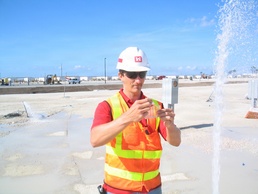
Signing up to deploy as a civilian member of the U.S. Army Corps of Engineers is a decision dedicated volunteers such as Jeff McCrery view as a calling, not just a duty.
“Everyone should try a deployment at least once,” McCrery said. “I encourage everyone to embrace the opportunity and get their feet wet. It’s a powerful experience, and from the first one, I was hooked.”
McCrery serves as the Rock Island District’s environmental compliance coordinator and sustainability program manager. In his day-to-day role, he ensures the District remains in compliance with Environmental Protection Agency regulations and federal codes.
“I work districtwide with all the locks and dams, lake projects and outgrants to ensure compliance,” McCrery said.
When deployed, however, McCrery has served in a variety of roles, including his most recent deployment as a member of the safety cadre.
When McCrery began his career with USACE in environmental engineering, he spent 12 years in that section. During early deployments, he served as a quality assurance specialist overseeing debris removal, housing and commodities, and later as a quality assurance supervisor.
“I started in the early spring of 1994,” McCrery said. “Since that time, I’ve deployed 10 or 12 times. The very first time I deployed I had no idea what I was getting into. I just saw it as the chance to do something different and challenging.”
Out of his many deployments during his more than 30 years as a USACE employee, McCrery said one stands out.
“It was in response to hurricanes Ivan and Charley in 2004,” McCrery said. “I was deployed to the Gulf Coast of Florida, in the Fort Myers and Naples areas. I felt very honored to be asked to contribute to the cleanup and rebuild after a natural disaster.”
While civilian deployments within USACE are often relatively short, some missions offer the opportunity for personnel to deploy multiple times in support of the same disaster.
In November, McCrery was asked to respond to Hurricane Helene in Asheville, North Carolina. He was stationed about two hours north, in Boone. A year earlier, he had deployed to Savannah, Georgia, in response to the same storm.
“When I was asked to come back a second time for Hurricane Helene, I couldn’t believe it was still going on,” McCrery said. “When I left Georgia, they were wrapping the mission up. It goes to show the amount of devastation a storm like this can cause to a community and its infrastructure.”
Deploying in the aftermath of a disaster is inherently dangerous. As a member of the safety cadre, McCrery is responsible for ensuring safety remains the top priority.
“There are always people who don’t buy into safety, and they take some convincing,” McCrery said. “We take a cooperative approach with everyone and try to explain that safety is for their own good. We know the job has to get done, but we don’t do it at the expense of safety. At the end of the day, we want everyone to go home safely. People are the mission, and we’ve got to protect the people.”
For those considering deployment, McCrery offered two pieces of advice: hydration and reintegration.
“During long, hot days in Florida or the heat of California, I’m always reaching for water,” McCrery said. “When I land, the first thing I do is pick up a few cases of water and keep them in the back of my vehicle to hand out to anyone who needs it — contractors, members of the public or fellow USACE employees.”
Reintegration after deployment is equally important, he said.
“When you have a wife and kids at home and you’re gone for 30, 60 or 90 days, that readjustment period is crucial,” McCrery said. “You had your routine, and your spouse had theirs. When you come back and reinsert yourself into that routine, there is always a period of adjustment, and you have to be cognizant of that.”