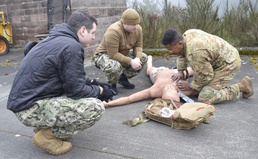
The U.S. Navy Tactical Combat Casualty Care course has long prepared hospital corpsmen for deploying to such locales as an isolated forward operating base to perilous stretch of littoral.
Navy Medicine Readiness Training Command Bremerton also provided crucial TCCC Tier III [a demanding version centered on handling life-threatening casualties] to U.S. Air Force 315th Aeromedical Evacuation Squadron personnel during the last few weeks of February 2026.
The arduous training was designed to hone their medical response skills in treating traumatic injuries on the field of battle from a hazardous rural landing zone or contested urban flightline.
“This TCCC Tier III opportunity aligned with our deployment timelines and offered a robust joint training venue. It was an opportunity to integrate with joint partners and ensure our Airmen receive the best available training to prepare them for real-world operations,” said U.S. Air Force Capt. Shane Ellis, 315th Air Wing public affairs chief, noting that the 315th Airlift Wing remains focused on generating combat-ready forces capable of rapid global mobility in contested environments.
Under the watchful gaze of Hospital Corpsman 1st Class (Fleet Marine Force qualified) Austin Santistevan, TCCC-Tier III instructor, the visiting Air Force personnel from Charleston Air Force Base, South Carolina, received intensive didactic module training before undergoing and completing their educational effort with actual hands-on application in the field.
“Just as TCCC is an operational necessity for our corpsmen before we deploy, we gladly accepted the 315th and the 24 airmen in the class to become fully qualified in TCCC Tier III,” Santistevan said.
The lesson plan included the principles and application of TCCC, with detailed guidance on handling massive hemorrhage, airway management, respiration assessment and management, wound packing and wrapping, along practicing on nasopharyngeal, cricothyroidotomy, chest seal, and pelvic binder skill stations.
According to Ellis, participating members of the visiting 315th represented a cross-section of the Aeromedical Evacuation Squadron, including officers and enlisted medical professionals.
“All are medical personnel integral to the AE mission set, ensuring deployable teams are cohesive, capable and medically ready,” explained Ellis.
There were training sessions on dealing with recognizing and managing shock, preventing and treating hypothermia, handling head and eye injuries. There were instructions on dealing with burns and fractures, and the administration of pain medication and antibiotics. Guidance was provided on battle dressing, wound wrapping, splinting techniques, as well as proper monitoring of wounded personnel, communication protocols, evacuation preparation and litter team fundamentals.
The week-long classroom sessions segued into applying the lessons with actual hands-on field testing by practicing emergency medical support and evacuation in a simulated combat environment.
“It was the perfect balance with what we’ve learned,” shared Tech Sgt. Cori Andrews, with the 315th Aeromedical Evacuation Squadron. “The pressure was on us to retain and put the lessons into actual practice.”
Amidst a mock firefight exploding around them, faux patient screams and bellowing demands from instructors, the 315th team were tested on conducting – with timely urgency - primary and secondary assessments, casualty movement, airway management, hemorrhage control, chest needle decompression, applying splinting and pressure dressings, and more.
“TCCC is foundational to survivability in modern conflict. Training reinforces prolonged casualty care in austere environments. This ensures our Aeromedical Evacuation professionals are tactically and clinically prepared to preserve life and sustain combat power from point of injury through strategic evacuation,” stated Ellis.
Assisting Santistevan were Chief Hospital Corpsman Lee Halls, HM1 German Rossete, HM1 Adam Toler, Hospital Corpsmen 2nd Class Yong Choe, Eli, Matthew Hegquist, Charles Oetting, Gage Schirmer, Emiley Wilkinson, Hospital Corpsmen 3rd Class Lucas Allen, Carmen Siverson, and Lew Tranca.
“They were fantastic. The instructors know and love what they do,” Andrews said. “It was like a real-life experience.”
The collaborative Navy and Air Force effort continues a long tradition of joint service effort.
“Operational readiness requires joint interoperability. Our Airmen will deploy alongside sister services and coalition partners in dynamic environments. Training hands-on in a joint setting strengthens cross-service coordination, standardizes medical procedures, and enhances our ability to seamlessly integrate into theater operations—directly supporting global mobility and agile combat employment,” Ellis shared.
Sending a sizable contingent for extended training can be a challenge. Yet the behind-the-scenes logistics proved to be another joint cooperative effort.
“As a Reserve wing, coordinating schedules, civilian employment, and mission requirements requires deliberate planning. Early coordination and command support are key. While there are short-term scheduling challenges, long-term readiness gains and standardized proficiency across the squadron significantly outweigh them,” said Ellis.
Santistevan cited the Navy TCCC Tier III course is primarily geared towards corpsmen, although open to other Sailors, as well as Marine Corps personnel.
“But this was a special course. Getting them certified to be ready to deploy is what we do,” said Santistevan.
“Partnering with a command that understands the urgency of medical readiness strengthens joint integration and overall Department of War preparedness,” added Ellis. “Their professionalism and responsiveness directly contribute to ensuring our wing remains a medically ready force prepared to operate in any theater.”
The 315th mission is supporting combat forces during contingency operations or other various conditions of heightened tension up to and including full mobilization, as well as humanitarian and peacekeeping efforts throughout the world.
NMRTC Bremerton primary mission focus is to ensure the readiness and deployability of Navy and Marine Corps forces. The joint collaboration effort with Air Force assets also adheres to the Defense Health Agency operational framework of being a combat support agency to help generate and sustain warfighter readiness.