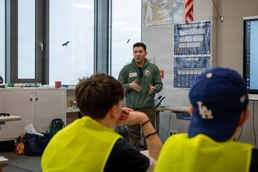
SPANGDAHLEM AIR BASE, Germany – More than 100 seventh and eighth-grade students from Department of Defense Education Activity schools across Europe gathered at Spangdahlem Middle School on Feb. 26 for the annual STEMposium, where they partnered with Airmen across the base to explore renewable energy, robotics and emerging technologies.
Students from DoDEA West, Central and East districts formed five “companies” focused on wind, solar, robotics, electronics and hydro/biofuel energy systems. Each team was tasked with designing a mechanism capable of powering a self-driving vehicle using only clean, renewable energy, according to Judy Mott, 52nd Mission Support Group school liaison program manager.
Airmen from the 52nd Civil Engineer Squadron and the 52nd Operations Support Squadron served as subject matter experts throughout the day, mentoring students and providing real-world insight into how renewable energy systems operate on military installations.
“Green energy is the wave of the future,” said Staff Sgt. Gilberto Trejos, 52nd CES electrical systems noncommissioned officer in charge. “It’s starting now and it’s slowly being phased in, you can see it everywhere, with cars and solar panels.”
Weather Airmen presented solar and wind energy concepts to 36 students during a single session, then remained as subject matter experts for wind tunnel demonstrations and follow-on discussions.
“It’s better to get an understanding while you are younger, not even with just electricity but renewable energy as well,” said Airman 1st Class Adriana Ray, 52nd CES electrical systems apprentice. “Just understanding how we impact the world with even turning off a light switch when you’re not using it and buying rechargeable batteries instead of ones that you dispose of.”
Emergency management Airmen highlighted robotics and hazardous response capabilities during their STEMinar. The team showed students video footage of a robotic dog opening a door during a training scenario and displayed specialized equipment, including a radioisotope identification device used to detect and analyze radioactive materials. The demonstration gave students insight into how technology supports force protection and emergency response operations.
“A part of my job is to mold the next person that will replace me and pass on any information, any knowledge, any skills that have been instilled in me,” Trejos said.
By connecting classroom concepts to real-world operations, Airmen at Spangdahlem Air Base helped ensure the next generation of innovators understands both the responsibility and opportunity that come with advancing renewable energy and emerging technologies.