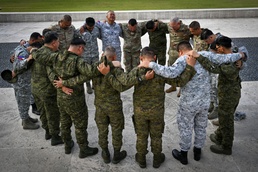
Chaplains from the Hawaii and Guam National Guards joined counterparts from the Armed Forces of the Philippines for a visit to the Manila American Cemetery and Memorial Feb. 21, reinforcing shared spiritual commitments and strengthening military partnerships in the Indo-Pacific.
For participants, the cemetery visit provided a solemn opportunity to reflect on the chaplain corps’ core mission: to nurture the living, care for the wounded and honor the dead. Walking among the headstones, several chaplains described a renewed sense of purpose in supporting service members and their families before, during and after times of crisis.
“We must continue to honor those who have served and those who have fallen in defense of freedom and justice,” said Chaplain (Lt. Col.) Charles Poore, Hawaii Army National Guard senior chaplain. “My time at the Manila American Cemetery reinforced my support of the great relationship that the Armed Forces of the Philippines and the U.S. Armed Forces have enjoyed for many years.”
The visit marked the culminating event of a four-day chaplain subject matter expert exchange conducted under the National Guard State Partnership Program, an initiative that links state National Guards with partner nations to build long-term, mutually beneficial security relationships.
The exchange brought together chaplains for classroom instruction, professional dialogue and fellowship, continuing more than 25 years of partnership between the Hawaii and Guam National Guards and the Philippines.
The Manila American Cemetery contains the largest number of graves of U.S. military personnel and Philippines fighters who died during World War II. A total of 16,859 service members are buried there, most of whom lost their lives in operations in New Guinea and the Philippines. The headstones are arranged in 11 plots forming a circular pattern, set among tropical trees and manicured grounds overlooking surrounding lowlands.
Inscribed on limestone walls within a semicircular memorial are the Tablets of the Missing, bearing 36,286 names of those whose remains were never recovered or identified. Rosettes mark the names of those since accounted for; currently, 439 rosettes appear beside names at the memorial.
During the visit, one chaplain from the Hawaii National Guard and one from the Guam National Guard participated in a flag lowering and folding ceremony honoring the United States flag. Two chaplains from the Armed Forces of the Philippines conducted a parallel ceremony for the Philippine flag. The synchronized tribute symbolized shared sacrifice and enduring alliance between the two nations.
The State Partnership Program engagement was a multi-state effort integrating personnel from both Hawaii and Guam. Throughout the four-day exchange (Feb. 18-21), chaplains discussed best practices in religious support operations, crisis response, moral injury care and strengthening unit cohesion. Participants shared experiences from domestic emergency response missions and overseas deployments, highlighting the evolving role of chaplains in supporting total force readiness.
The inclusion of the cemetery visit provided historical and spiritual context to those discussions. Standing before rows of white marble headstones and the names etched into the Tablets of the Missing, chaplains were reminded that strategic partnerships and readiness initiatives ultimately center on the individual service member.
“The visit at the cemetery reminded me of a shared history where we have served together with great distinction and honor,” Poore said. “It reminded me of the importance of such strategic relationships with our partners.”