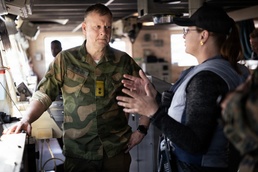
Norway Army Maj. Gen. Anders Jernberg, commander of the Norwegian Defense Logistics Organization and the Norwegian armed forces’ top logistics officer, visited Marine Corps Support Facility Blount Island to reinforce the decades-long Marine Corps Prepositioning Program–Norway partnership and explore expanding sustainment capacity in Europe.
Joined by political adviser Frode Bjerkås and Norway Navy Capt. Connie Stein, naval and assistant defense attaché at the Norwegian Embassy, Jernberg met Feb. 27 with U.S. Marine Corps Col. David Merles, commanding officer of Blount Island Command, to discuss rapid response, distributed operations and deterrence in the High North.
The visit reflects growing emphasis on Arctic logistics resilience as allied forces adapt to evolving security conditions in Northern Europe.
“Today it’s logistics that wins or loses wars,” said Jernberg, who leads joint logistics for Norway’s Armed Forces and reports directly to the chief of defense. He described logistics as the pacing function of modern conflict. “Logistics requires skilled people working closely together. We are on the same team.”
During a capability brief, Blount Island Command leaders highlighted maritime prepositioning force capabilities, including the Improved Navy Lighterage System, which enables equipment to transition from sea-based platforms to forces ashore without reliance on fixed port infrastructure.
Maj. Kelly Streck, director of ashore prepositioning, described the Norway program as a mature partnership built on mutual trust and cost sharing. The program sustains a 90-percent-plus equipment readiness rate through disciplined lifecycle management, proactive maintenance and modernization.
Norwegian personnel maintain and account for prepositioned equipment daily, strengthening interoperability and enabling rapid integration during joint operations. Equipment sets align with NATO standards, allowing U.S. Marines and allied forces to operate seamlessly.
“The program is maintaining a high level of readiness,” Streck said, noting recent maintenance and supply assessments validated equipment accountability, internal controls and the accuracy of readiness reporting. Leaders also discussed expanding equipment sets.
Jernberg expressed interest in formal collaboration with Marine Depot Maintenance Command, the Marine Corps’ center of excellence for advanced manufacturing solutions, to sustain combat systems and build repair capacity in Europe while reducing reliance on extended supply chains.
Merles emphasized that linking Norway’s high-readiness prepositioning enterprise with advanced manufacturing expertise would strengthen resilience across allied sustainment networks.
“Norway is the gold standard for ashore prepositioning,” Merles said. “If we are expanding advanced manufacturing capacity, Norway is a logical next step.”
Marine Corps prepositioning programs rely on a blended workforce of service members, civilians and contractors to sustain inventory accountability, inspections, lifecycle maintenance and global distribution. That approach reinforces audit standards while preserving combat-ready capabilities.
During the visit, two Military Sealift Command ships were docked in the facility’s 1,000-foot slipway. USNS Dahl had recently returned for offload operations, while another completed a maintenance cycle that regenerates combat power for global prepositioning requirements.
Jernberg toured USNS Dahl, a 950-foot maritime prepositioning ship, where contracted captain Deatra Thompson outlined cargo operations, flight deck capabilities and afloat maintenance practices that preserve readiness during forward deployments.
“This is one of the best-led and maintained programs ever for prepositioning,” Jernberg said, referring to the climate-controlled cave complexes in Norway. “The best part of the visit is seeing the people working here, shaking their hands, looking them in the eyes and knowing we are on the same team.”
He highlighted the continuity and culture of the workforce, pointing to strong bonds, shared history and pride in the mission as factors behind consistently low turnover.
“You can see it in their eyes,” Jernberg said. “Strong women and men.”