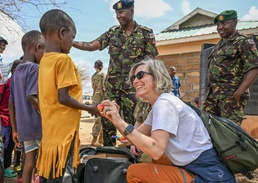
ARCHERS POST, Kenya — U.S. service members, Kenya Defence Forces and local civilian medical teams delivered critical healthcare to Samburu County communities during a Medical Civic Action Program (MEDCAP) as part of Justified Accord 2026, Feb. 26–27, 2026.
The combined team of U.S. Army, U.S. Air Force and KDF treated approximately 1,200 patients across two days at Archers Post Sub-County Hospital and Laresoro Dispensary, providing essential role one care while strengthening multinational partnerships and improving crisis response readiness.
The MEDCAP served as a practical training opportunity during the multinational exercise, allowing medical professionals to operate in austere conditions while delivering direct care to underserved communities.
“This year we doubled the size of the team and for the first time had a joint team of Army and Air Force from components one, two and three, increasing overall Department of Defense interoperability and readiness,” said U.S. Army Lt. Col. Amanda Owens, civil affairs officer assigned to U.S. Army Southern European Task Force, Africa (SETAF-AF).
Owens also highlighted how new medical technology enhanced patient care during the mission.
“The portable ultrasound machines, which to my knowledge weren’t brought to previous MEDCAPs, enhanced the level of care the team was able to provide to the community, which otherwise has no ultrasound capability,” she said.
Medical providers used the portable ultrasound systems to diagnose conditions that might otherwise go undetected in remote environments.
In addition to general medical services, dental providers addressed a significant gap in local healthcare access. The Massachusetts National Guard dental team delivered oral hygiene instruction, triaged patients for preventive and restorative care, and performed extractions on teeth deemed non-restorable.
U.S. Army Maj. Diana Li, a dentist assigned to the Massachusetts Army National Guard Medical Detachment, worked alongside KDF Capt. Daniel Arusho, a dentist with the Kenya Defence Forces, to treat patients who often have limited access to dental care.
“No dental services are currently available at Archers Post Hospital or Laresoro Health Centre,” Li said. “Our team was honored to provide essential dental care to the local communities.”
U.S. Army Capt. Elijah Taylor, a physician assistant with the Massachusetts Army National Guard’s 3rd Battalion, 126th Aviation Regiment, said the technology proved critical in evaluating serious conditions.
“Dr. [Lt. Col.] Benjamin Krainin and I also did cardiac and lung ultrasounds to evaluate for, and identify heart failure,” Taylor said.
U.S. Army Lt. Col. Benjamin Krainin, MD, brigade surgeon for the 173rd Mobile Brigade Combat Team (Airborne), added that the equipment enabled providers to diagnose and monitor patients in a resource-limited setting quickly.
“I performed a few dozen bedside ultrasounds, predominantly to assess fetal well-being in pregnant patients—and found twins,” said Krainin. “Every provider likely saw between two and three times the patient load that would have been handled on a typical emergency room shift.”
Beyond improving diagnostic capability, the MEDCAP exposed U.S. providers to diseases and conditions rarely encountered at home.
“MEDCAPs are an opportunity for U.S. providers to be exposed to disease processes that are rare or nonexistent in the United States, enhancing our deployed clinical skills,” said U.S. Army Maj. Ryan Haug, a physician assistant with Special Operations Detachment–Global, Rhode Island Army National Guard. “The opportunity to engage with partner forces and collaborate to care for people in need enhances interoperability and reinforces our country’s dedication to an important ally.”
Haug’s participation also highlighted the National Guard’s ability to leverage partnerships across multiple states through the State Partnership Program, bringing together expertise from across the force.
For Air National Guard medics, the mission offered training opportunities unavailable in most stateside settings.
“In JA26, I play the role of an aerospace medical technician, also known as a medic,” said U.S. Air Force Staff Sgt. Kyle Kendall with the 104th Medical Group, Massachusetts Air National Guard. “It’s extremely important that we bring our airmen to Africa because there are so many skills we aren’t able to train on [in a military setting] back in the United States, such as caring for pediatric, geriatric and pregnant patients.”
Kendall said ultrasound technology proved especially valuable in diagnosing conditions during the mission.
“In the medical world, ultrasound is continuing to grow in its usage and could potentially replace a stethoscope,” he said. “We were able to diagnose many different conditions that we normally would not have.” At Laresoro Dispensary, the team treated approximately 585 patients in a single day, providing assessments, medications and follow-up care to residents from nearby communities.
KDF personnel emphasized that the MEDCAP also reinforced professional military cooperation and operational readiness.
“Today we are conducting a medical camp as a culmination of joint training activities with the U.S. military and other partner nations in exercise Justified Accord 26,” said KDF Col. Mohammed Omar, a MEDCAP organizer. “We are learning new skills, sharing experiences and preparing ourselves for operational activities. Training is a continuous process so that we remain ready for missions.”
Members of the Massachusetts National Guard highlighted the dual benefit of humanitarian assistance and professional development during the exercise.
“Kenya has been our state partner for the past decade, so we’re strengthening the relationship we have with Kenya while also strengthening our medical skills,” said U.S. Army Capt. Bridget Keefe, a medical-surgical nurse with the Massachusetts Army National Guard Medical Detachment. “Here I was able to fully immerse myself in hands-on patient care and bring the skills I use as a surgical intensive care unit nurse in my civilian job into this mission.”
Medical leaders overseeing the mission said the MEDCAP demonstrated how joint and multinational teams can rapidly deliver care during humanitarian crises while improving readiness across the force.
“In JA26, I serve as the medical operations officer for the MEDCAP activities in Samburu County,” said U.S. Army Lt. Col. Katherine Murphy, deputy commander for administration and global health engagement liaison for the Massachusetts Army National Guard. “Our Soldiers and Airmen had the opportunity to train, validate and execute critical tasks while working directly with our KDF health partners and community health workers.”
Murphy noted that the integration of point-of-care ultrasound alongside multinational medical teams significantly improved diagnostic capability and clinical outcomes.
“Bringing our Soldiers and Airmen here helps build trust with our partner nation, increases interoperability and improves learning opportunities with our Kenyan partners,” she said.
Led by U.S. Africa Command and organized by SETAF-AF, Justified Accord 2026 is the largest U.S. military exercise in East Africa. Hosted in Djibouti, Kenya and Tanzania, the exercise includes personnel from approximately 15 partner nations.
The exercise strengthens multinational interoperability in support of humanitarian assistance and crisis response while preparing regional partners for missions with the United Nations and African Union.
For Murphy and many of the participating service members, the mission represented more than training—it was a chance to make a lasting impact.
“Getting to be part of JA26 is one of the biggest highlights of my career,” said Murphy. “This is why I joined the military—to make an impact not just on one person, but many.”