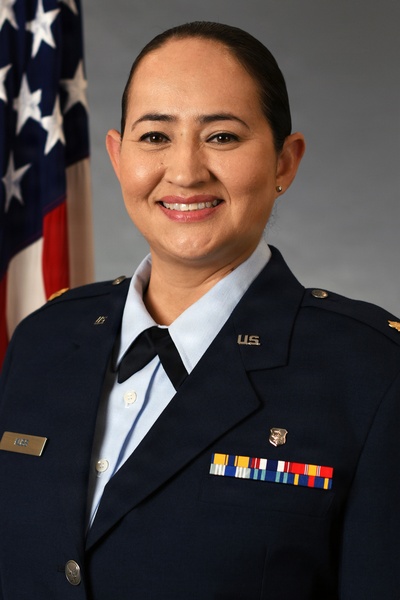
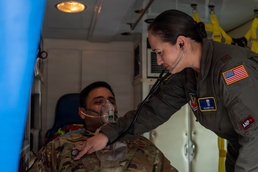
The small, brain-shaped coin felt heavier than its size, a quiet symbol of gratitude that brought tears as she recalled its meaning. It was a gift from an Air Force airman she once treated for lymphoma, presented to her after he not only completed treatment, but beat the cancer.
He honored his doctor by coining her — a tribute usually performed by senior leaders to recognize airmen. The gesture represented the trust placed in her during one of the most difficult moments of the airman's life.
"This is my favorite coin, and it reminds me how special this [moment] was for both of us," said Air Force Maj. Elizabeth Kuss, 325th Operational Medical Readiness Squadron flight medicine flight commander. "I don't do this job to be thanked, but it was so special to be thanked in this way."
The experience was shaped by a path she once believed she would never take; one she believed was not for her.
![An airman sitting in the passenger seat of an ambulance smiles and looks out of an open window during daytime, with a building in the background.]()
Job:
Aeromedical Nurse PractitionerStationed:
Tyndall Air Force Base, Fla.Unit:
Air ForceHometown:
Prattville,Ala.Raised as an "Army brat" and surrounded by military service, Kuss had long resisted joining the military. Her father served for 30 years in the Army and for another 20 as a civilian supporting Army aviation, while her brother joined the Air Force in 2000.
"I was the one saying, 'I'm not joining the military,'" she said, laughing. "Turns out my dad was right."
By 2020, amid the COVID-19 pandemic and nearing a milestone birthday, Kuss said she felt professionally stagnant.
"I wanted more — personal growth and professional growth," she said. "I was asking myself, 'Is this it?'"
The need for a new challenge is what drew her to military medicine. After nearly two decades working in emergency rooms in Alabama, Kuss became an Air Force nurse practitioner at 40 years old, trading night shifts and a familiar hospital system for operational medicine, intense training and a role few in uniform have ever filled.
"I knew this was not going to be easy. This was not going to be a cakewalk kind of job," Kuss said. "But this is my dream job. I get to take care of the most amazing people while doing the things I love."
Inspired by Air Force nurse practitioners who were deploying, leading and operating far beyond the clinic, Kuss commissioned directly into the Air Force in 2021 as a family nurse practitioner. She was assigned to Joint Base Elmendorf-Richardson, Alaska, which quickly became a turning point.
Within months, Kuss attended military mountain medicine training, climbing and rappelling with litters, navigating austere terrain and learning trauma care under simulated combat conditions.
"They made it as real as possible and that was the moment I thought, 'This is what I signed up for,'" she said. "You don't get to do this [training] on the outside. It really solidified my decision to do this."
After two years in active-duty medicine, she was selected for the Air Force's aeromedical nurse practitioner training pipeline, a career field that was created in 2019 to bridge the gap between medicine and mission. The pipeline included aerospace physiology, altitude chamber exposure, centrifuge training and flight operations.
"The goal is to have a better understanding of what aviators and defenders go through," Kuss said. "Does this [medical] condition impact their ability to fly? Their ability to see screens? If I understand what duties they're undergoing, I can better understand how that might impact them medically."
![An airman in a flight suit sits and smiles at a table with food on paper plates, green decorations and other people indoors.]()
As an aeromedical nurse practitioner, Kuss does far more than traditional primary care. Her role spans occupational health, deployment clearances, public health and flight-related medical emergencies. Between these responsibilities, she also manages administrative tasks such as reviewing profiles, signing medical clearances and advising commanders on readiness risks.
"It's always a balance," she said. "You're taking care of someone as a person, but you're also responsible for military readiness and mission safety, and asking yourself, 'Is it going to compromise the mission because they aren't able to perform their duties?'"
Trust between the patient and provider sits at the core of Kuss' work as one of roughly 50 aeromedical nurse practitioners across the Air Force. In April 2024, she arrived at Tyndall Air Force Base, Florida, as the base's first aeromedical nurse practitioner, stepping into a role that brings both opportunity and pressure.
"I want to show that we're value-added," she said. "I want to show that we support the mission and that as a [career field], we're needed. When I leave, I want them to say, 'We need another one.'"
As an emerging career field, Kuss said aeromedical nurse practitioners often face misconceptions, including being underutilized or misunderstood.
"People don't always know what we can do," she said. "That knowledge gap is probably the biggest barrier. With more exposure and time on the lines, we can break those barriers and learn how we fit within a squadron and how we can be an asset to the team."
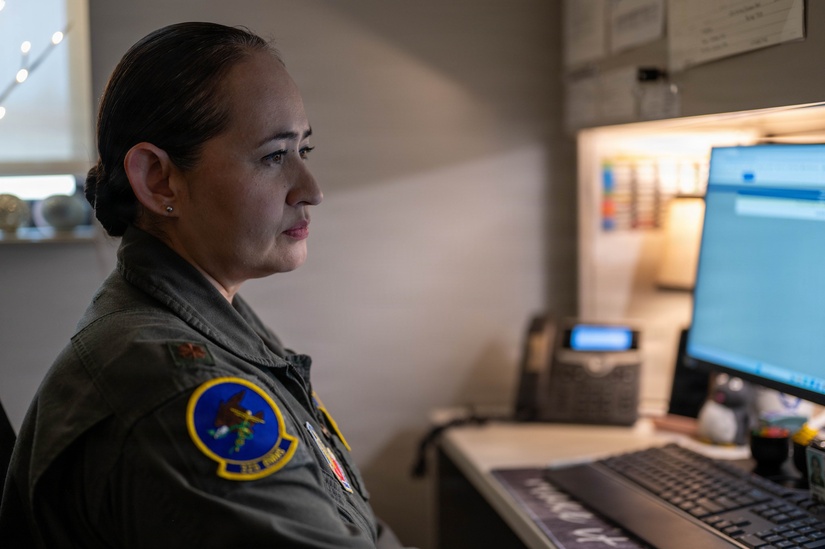
For those who work with her, her impact and influence are already clear.
"She's everything you'd want in a provider and a flight commander," said Air Force Tech. Sgt. Joseph Smith, 325th OMRS flight operational medical technician. "She listens. She's empathetic. She treats everyone like a person first."
Smith said Kuss' aeromedical expertise has been especially valuable during in-flight emergencies involving F-35A Lightning II pilots experiencing hypoxia-like symptoms.
"Her being an aeromedical nurse practitioner makes all the difference sometimes," Smith said. "She already knows what's going on when it comes to altitude, aircraft systems, all of it. She's always clocked in with the engine running.
"She's big on readiness because she knows if we don't take care of pilots and maintainers, the mission doesn't happen," Smith continued. "She sets the standard — anyone who comes into this role should look at her and say, 'That's what an aeromedical nurse practitioner should be.'"
Looking ahead, Kuss hopes to deploy, support humanitarian missions and continue shaping a career field still defining itself.
"I've only been in five years, and I've already done things I never imagined," she said. "And there's still so much more to do, so many more boxes I want to check off. I'm ready for whatever comes my way."