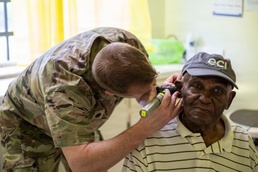
BASSETERRE, Saint Kitts — For many families across Saint Kitts and Nevis hearing care has long meant limited access. The two-island Federation relies on a single ear, nose and throat specialist, leaving many residents without consistent access to comprehensive hearing care.
During the 2026 Lesser Antilles Medical Assistance Team mission, U.S. Air Force audiologists are helping change that — not just through screenings and hearing aid fittings, but by working with the Federation’s leadership toward a national solution.
This week, Ministry leaders convened a national workshop to begin formal development of a hearing program — an effort aligned with the Federation’s broader focus on strengthening health systems and expanding access to specialized care.
“This consultation is a first step in developing a national hearing plan,” Curtis Martin, Saint Kitts and Nevis permanent secretary, said while opening the session. “Hearing loss is present in our population — and there are individuals living with unmet needs. With the right intervention, we can meet those needs.”
The workshop brought together LAMAT audiologists, non-governmental organization (NGO) audiologists and representatives from both island’s health services, early childhood development and education and community outreach to assess gaps, evaluate data and outline what a structured, sustainable audiology program would require.
A central focus of the discussion was the feasibility of implementing universal newborn hearing screening across the Federation — an achievable benchmark, leaders noted, given the country’s size.
“There are about 600 births on the island each year,” Foster said. “That’s manageable. We could realistically screen every single newborn and ensure no child slips through the cracks.”
Providing care during LAMAT — and helping facilitate the planning session — was U.S. Air Force Lt. Col. Johnny Foster, 711th Human Performance Wing audiologist returning for his third consecutive LAMAT mission to Saint Kitts and Nevis.
Foster, who is also a co-founder and member of Hear for a Purpose (HFAP), an audiology-focused NGO, has seen firsthand the recurring need for hearing services across both islands. This iteration, Foster, HFAP members and fellow Air Force audiologists teamed together to provide care during the two-week mission while helping Ministry officials map out a long-term solution.
“When you come back year after year and see the progress, you realize this can’t just be a two-week mission once a year,” Foster said. “If we’re serious about building something that lasts, it takes commitment on both sides — and that’s what we’re seeing here.
“We’re here to provide care during LAMAT, but just as importantly, we’re here to help build a system that continues long after we’re gone.”
Over the past week, the team of five audiologists has conducted newborn hearing screenings in hospital wards, performed comprehensive diagnostic evaluations, fitted new hearing aid patients and conducted follow-up visits for individuals who received devices during previous missions.
The LAMAT audiologists also provided hands-on training for local health professionals, including instruction on taking ear impressions to create hearing aid molds — a technical skill necessary for sustaining services locally.
“We don’t want to simply show up, fit hearing aids and leave,” Foster said. “The goal is early identification, appropriate treatment and a pathway for long-term follow-up — all managed here within the Federation.”
For many residents, the impact is immediate. For the government, the goal is structural.
“Ultimately, this is about improving quality of life — hearing health affects communication, education, productivity and independence,” the permanent secretary said. “This meeting is foundational.”
While the Federation works toward building permanent capacity, LAMAT continues to provide care in the short term. The partnership model allows Air Force audiologists to operate in a resource-limited environment, strengthening their own expeditionary medical readiness while integrating directly into host-nation systems.
“For our Airmen, this is readiness in action,” Foster said. “We’re delivering specialty care outside of a traditional clinical setting, adapting in real time and working side by side with partner-nation professionals. That experience sharpens our skills and prepares us for wherever we’re called to serve next.”
Foster continued on, explaining what makes this year different is the visible government commitment and sustained engagement beyond the annual mission window.
“It’s still baby steps, but there’s real momentum,” he said. “We’re not just waiting until next year to talk about it again. The relationships are strong, and we’ll stay engaged throughout the year to keep building. With the commitment we’re seeing from the government and the people at the table, I’m excited about where this is headed.”
He’s confident the Federation will turn discussion into action.
“They want this,” Foster said. “They’re excited about it, and they have champions at every level. When you have that kind of backing, real change happens. I’m excited for what the next year looks like — and I truly believe this is going to move forward.”
Across Saint Kitts and Nevis, LAMAT 2026 may only last two weeks … the national hearing program now in development, is designed to last far longer.