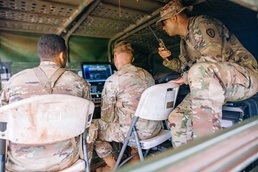
SCHOFIELD BARRACKS, Hawaii –25th Infantry Division Soldiers concluded Lightning Surge 2 Friday, Feb. 27, a week-long event focused on evaluating the Army's Next Generation Command and Control prototype. The operational prototyping and training event was intended to improve Soldier lethality by rapidly delivering data for long-range fires and enabling faster, more informed battlefield decisions, thereby improving response speed and mission effectiveness. The exercise showed that while new technology is an effective enabler, the Soldier remains the most vital component of modern warfare.
Next Generation Command and Control, or NGC2, is a key part of the Army’s effort to modernize its forces, and for the Tropic Lightning Division, that means the planning for the unique challenges of the Indo-Pacific theater. NGC2 is intended to enable faster decision-making, improved responsiveness, and enhanced mission success in environments where speed can mean the difference between success and failure.
"The benefits of what we're doing here – in the iterations we're doing with industry – is really getting after the artillery aspects of how we see and sense a target, and how we quickly transmit the information from what is seen and sensed to our guns through multiple different paths for resiliency," said Maj. Gen. James B. Bartholomees, commanding general of the 25th Infantry Division and U.S. Army Hawaii. "Because ultimately, [as] we're learning from the war in Ukraine …we have got to constrict this cycle down. We've got to make it shorter."
At the heart of this challenge is a complex problem that the military has faced for decades: getting separate, specialized computer systems to communicate seamlessly. For Soldiers on the ground, this has often meant manually relaying information from one screen to another, a time-consuming process prone to error.
NGC2 aims to provide capability to address that challenge, incrementally expanding through a series of technical and operational “sprints” with Soldiers and industry. As one of these sprint events, Lightning Surge 2 focused on several difficult parts of the network: the "first mile" from the sensor and the "last mile" to the weapon system.
"What we have done the last two weeks is we've upgraded the last mile, the launchers and the guns, with updated radio systems and also private 5G," said Lt. Col. Adam Brinkman, the 25th Infantry Division’s G6 and 125th Division Signal Battalion commander. "And what that has allowed us to do is to provide more options to the formation on how to accelerate and send the missions all the way out to the edge."
During the exercise, Soldiers executed a real-world test of the digital kill chain. The process began with a forward observer identifying a simulated enemy target. Instead of radioing coordinates, the operator used a digital device to send target data into the network. That data instantly appeared on a shared digital map at the command post. Leaders quickly verified and approved the mission with a few clicks. The approved fire mission then went to a gun crew on an M777 howitzer. This eliminated manual data entry and greatly reduced time and errors common with voice commands. Switching from manual to automated processes denotes a significant leap in effectiveness and accuracy, according to experienced noncommissioned officers.
Sgt. Maj. Kenneth Alexander, the operations sergeant major for 25th Infantry Division Artillery, explained that dramatically shortening the time it takes to execute a fire mission directly increases a crew's survivability. "I can shoot and move and not have to worry about getting counter-fired,” Alexander said. “Basically, it keeps our own people safe.”
Ultimately, the Next Generation Command and Control prototype’s success will be determined by Soldiers. Their feedback gives Army developers vital data. It identifies effective features and areas for improvement. This ensures the ecosystem will better fit operational needs and Soldier workflows. The Lightning Surge Soldier-led “campaign of learning” continues in late April, when lessons from Schofield Barracks will inform operations during Lightning Surge 3 in the Philippines. This iterative process accelerates modernization and ensures technology meets real-world demand. As the battlefield becomes more data-centric, the American Soldier remains its most vital asset.