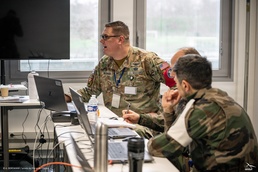
TOULOUSE, France — The 57th Space Aggressor Squadron played a vital role in SparteX 2026, French Space Command’s annual simulated space exercise, through advising on space domain planning, teaching Orbital Warfare principles and providing a dynamic adversary, or “red team,” for “blue team” friendly forces to play against Feb. 8-27, at French Air Base 101 "General Robert Aubinière.”
Formerly AsterX, SparteX is a unique exercise in Europe, aiming to train and certify French Space Command units for military space operations in a realistic, complex and fully interconnected simulated environment with other domains. This year, 200 people from across Australia, Canada, France, Germany, Italy, Japan, Norway, Poland, South Korea, Spain, Switzerland, United Kingdom and United States put their capabilities to the test during the exercise, while an additional 20 countries observed.
This is the third time Space Delta 11’s 57th SAS has participated in the exercise. The scenario included 28 simulated events including notional orbital warfare scenarios dealing with space launches, 4,000 simulated space objects and 10 different types of threats.
U.S. Space Force Capt. Daniel Jaquish, 57th SAS standardization and evaluation flight deputy flight commander and the red team chief for the exercise, highlighted how SparteX’s red team was multi-national, composed of both French and U.S. personnel, a unique experience for the U.S. aggressor team.
“SparteX provides an opportunity for the U.S. team to integrate and provide expertise in a multi-national simulated training environment,” Jaquish said. “Every country provides different levels of strategic, operational and tactical planning to events like these.
“As the space domain continues to become a more contested, degraded and operationally limited environment,” he continued, “it’s important that we train alongside other countries as we have been doing in all other domains.”
Working directly with the red opposing force leader, the 57th SAS helped pull together data from all domains to inform injects for future exercises. Together, they provided an essential thinking adversary to the nearly 170 blue players present at the exercise, requiring them to react in real time to simulated near-peer adversary actions, driving deeper knowledge and lessons learned.
U.S. Space Force Maj. Lydell Scott, 57th SAS deputy commander and SparteX space warfare officer, valued the collaboration with foreign partners while working through the scenarios and during down time events.
“I absolutely loved working with our foreign partners overseas,” Scott said. “I got a chance to work through and fix some tough model and simulation problems with our French counterparts. I learned about the military space programs in the U.K., Spain and Italy by interacting with our foreign partners during a SparteX social.”
U.S. Space Force Capt. Sean Wilkinson, 57th operations flight commander and SparteX space warfare officer, agreed, saying his experience was enlightening.
“SparteX26 is the first time I have integrated extensively with foreign partners and the experience has been phenomenal,” Wilkinson shared. “The French have been outstanding hosts and all personnel I’ve interacted with have been eager to share knowledge, culture and personal stories.”
Working alongside foreign partners, the team was able to provide their expertise and support throughout the scenario, but the exercise still posed some challenges.
“One of the most challenging aspects of this exercise has been the execution of the modeling and simulation across so many countries,” Jaquish said. “From a technical aspect, many countries are using separate systems to plan and execute their mission plans in a simulated environment.”
Jaquish went on to discuss how leading in and adapting to an environment using vastly different planning processes, systems and common operating pictures presents a complex problem set, but through collaboration and practice, their teams were able to overcome these obstacles.
According to Sgt. Whitney Cyree, 57th SAS intelligence flight noncommissioned officer in charge and SparteX information operations and intelligence lead, communication allows for deeper engagement.
“In a multinational space exercise, clear and concise communication is key to ensure all participants understand intent,” Cyree shared. “From this experience, the team was able to hone their communication skills for future allied and partners exercises to enable a successful learning environment for all participants.”
The 57th SAS team’s integration in SparteX allowed them to not only sharpen their own skills, but also coach participants and improve proficiency of partnering exercise operators. The work put into SparteX directly affects France’s high-intensity inter-service exercise, ORION 26, designed to prepare for a large-scale military operation involving combined forces in all domains of conflict and warfare.
“The space domain and the actions we take there are increasingly more of a collaborative effort,” Jaquish said. “We can’t deny the strength of growing these partnerships and realize the potential of such efforts as force multipliers to our future priorities and efforts as a force. Leveraging exercises like SparteX are a great way to practice and refine our plans and processes on how we can integrate with partners in the future.”