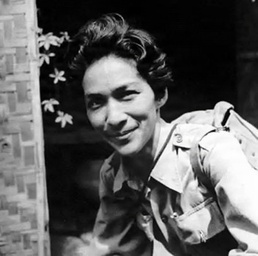
In March 1942, Yay Panlilio, a journalist and U.S. Army intelligence agent in the Philippines, signed off her final radio broadcast for Japanese-controlled KZRH by declaring her support for the Allied resistance. Forced into hiding, she soon found herself co-leading a Filipino guerrilla unit on Luzon.
Valeria “Yay” Panlilio was born in Denver, Colorado, in May 1913. She moved to the Philippines in the early 1930s and became a respected newspaper journalist and radio broadcaster for KZRH, Radio Manila. By 1939, Panlilio was cognizant of the encroaching Japanese presence and the looming threat of war in the Philippines. Her reports brought her to the U.S. Army’s attention because she could access areas military intelligence agents could not due to her heritage and work as a journalist.
Capt. Ralph Keeler, intelligence officer at Fort Santiago, recruited Panlilio to continue investigating the situation in the Philippines and report “everything interesting” back to the S-2. She was sworn in as an intelligence agent and given an Army badge. She supplied information to headquarters throughout 1941, including intelligence on the bombing campaign in Baguio on Dec. 8, 1941, following the attack on Pearl Harbor. As the Japanese descended on Luzon and General Douglas MacArthur’s staff withdrew from Manila, Panlilio was barred from following the Army to Bataan.
She remained in Manila when it fell to the Japanese on Jan. 2, 1942, and resumed working for KZRH, now under Japanese control. If she could not join the Army, she would continue to support the Allies from Manila. She spoke carefully in the hopes her intelligence contacts, friends working for the Allied radio station Voice of Freedom, and various guerrilla units, were listening.
"I tightroped and triple-talked in and out of the Japanese-censored scripts, trying to accomplish three things: advise the truculent, unarmed Manilans to look before they leaped; tip off the Voice of Freedom what to say instead of what it was saying; inform the Filipino-American forces by the most delicate innuendo what was going on behind enemy lines, innuendo so obscure sometimes that only mental telepathy could decode it."
As difficult and dangerous as Panlilio’s double-speak was for her safety, it worked. She later learned Maj. Gen. Charles Willoughby, U.S. Army Forces, Far East G-2, was aware of her broadcasts and used them to remain apprised of the situation in Manila.
In early March 1942, Panlilio was being pressured to give up her friends now serving the Allies. In her final broadcast for Radio Manila, Panlilio spoke directly to her former editor who was with MacArthur in Bataan: “Wherever you are, put up your feet and listen. We to whom you were a father—we will keep the faith.” Her arrest was immediately ordered, and Panlilio went into hiding.
She soon became entrenched with the Marking Guerrillas, named for and commanded by Col. Marcos “Marking” Agustin. “Colonel Yay,” as she was known, became the unit’s second in command, taking on many of the group’s administrative responsibilities as they fought the Japanese across Luzon over the next few years. Agustin later claimed, “there was not a man among his followers who would not have given his life for her.”
The Marking Guerrillas worked with the Counter Intelligence Corps (CIC) during the American landings on Luzon in January 1945, and during the Battle of Manila in February, they were responsible for capturing Philippine president Emilio Aguinaldo and transferring him to the CIC for interrogation. Panlilio returned to Manila with the Signal Corps after the city’s liberation and, having fallen out with Agustin, was determined to return to America. By May 1945, she had already left the Philippines when the Marking Guerrillas, formally inducted into the U.S. Army as the Yay Regiment, secured the Ipo Dam on the Angat River. The unit’s success at the dam etched Panlilio’s name on U.S. military history.
In 1950, Panlilio published her autobiography of her time as a journalist, intelligence agent, and guerrilla leader, and was awarded the Presidential Medal of Freedom by President Harry S. Truman for her actions in the Philippines. She passed away in New York in 1978.
Article by Erin E. Thompson, USAICoE Staff Historian. New issues of This Week in MI History are published each week. To report story errors, ask questions, request previous articles, or be added to our distribution list, please contact: TR-ICoE-Command-Historian@army.mil.