AURORA, Colo. — Space Training and Readiness Command personnel attended and highlighted the importance of perpetuating an innovative and collaborative culture as the Space Force continues to grow at the Air and Space Force Association’s Warfare Symposium Feb. 23-25.
The Warfare Symposium is a professional development event that gives the U.S. Air Force, U.S. Space Force, industry and joint and allied forces a platform to focus on the critical concerns and challenges of joint warfare. STARCOM attendees had the chance to witness leadership panels, engage in networking opportunities and visit industry exhibit halls to integrate and learn from subject matter experts from across the world.
Courage and Connection
STARCOM’s participation kicked off with the annual Polaris Awards where Sgt. Michael Campos, 33rd Range and Aggressor Squadron, Space Delta 11, and 1st Lt. Robert Bartkowiak, 3rd Test and Evaluation Squadron, Space Delta 12, were recognized for their courage and commitment to the mission and their teammates.
Following the awards presentation, all five winners sat down with Chief Master Sgt. of the Space Force John Bentivegna to discuss how they lead using the Space Force core values.
During the discussion, Campos and Bartkowiak emphasized the importance of integrating all capabilities to ensure understanding and domain awareness among Guardians. Bartkowiak also shared his experience as a test project officer, and how empowering Guardians to make operational decisions helps achieve mission success.
“I think it’s hard to approach the situation and say, ‘I want to take the risk, so the warfighter doesn’t have to,’” Bartkowiak said while discussing his approach to leadership and assuming risks. “I appreciate our chain of command who has delegated as many authorities to my level as possible so I can make those real time risk management decisions.”
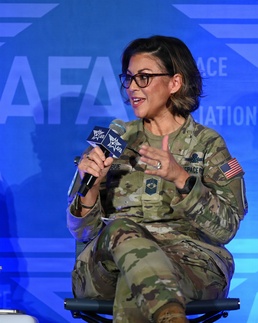
At a later panel titled Readiness for Anything: Leadership in the Trenches, Chief Master Sgt. Karmann-Monique Pogue, STARCOM command senior enlisted leader, expounded on this idea, discussing how deep knowledge and a critical mind can drive innovation and problem solving.
“Our Guardians are asking questions,” Pogue said. “They understand the threat. They know what we’re up against.
“It goes back into how we’re investing in the opportunities for our Guardians moving forward,” she continued. “What we’re asking our (Guardians) to do is reinforce, at every level of leadership, that critical thinking mindset.”
Growth and culture
During the symposium, several leaders, including Chief of Space Operations Gen. Chance Saltzman, discussed how the Space Force will experience significant growth in the coming years to match the pace of adversaries.
In a panel on realistic training for the space domain, Maj. Gen. James E. Smith, STARCOM commander, reminded the audience that the expansion will include both the operational community and the infrastructure that supports them.
“As the demand for combat credible space operators increases, the training courses, instructors and facilities must grow to meet those requirements,” Smith said after the panel. “It is our job at STARCOM to build and develop that framework and ensure our Guardians have what they need to fight and win.”
Brig. Gen. Matthew Cantore, STARCOM deputy commander, shared how the command has already made significant progress in meeting current growth and sustainment demands.
“This last year has been monumental as we’ve rolled out the new officer training course,” Cantore said. “And now we put together a far more academically rigorous and grounded background for space operations, cyber operations, intel and acquisitions than we ever did before and we’re already seeing the dividends pay off.”
Cantore went on to emphasize the work STARCOM is doing to advance Guardian enlisted and civilian training and education within the service.
Though many programs are just starting out, instructors and facilitators are already adapting curriculum to improve for future Guardians and partners. STARCOM personnel understand these foundational courses will set the bedrock of the service’s mindset and culture going forward.