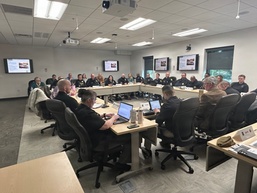
FORT DETRICK, Md. —On February 26, representatives from Frederick County Fire and Emergency Services, City of Frederick first responders, the National Cancer Institute (NCI) Frederick, US Army Garrison Fort Detrick and
other federal agencies came together for an active assailant workshop hosted by the Garrison Directorate of Emergency Services Protection Division. This workshop highlighted the importance of community relationships, collaboration, and emergency preparedness in ensuring the safety and security of employees, service
members, and the surrounding community.
Fort Detrick is unique in that the National Cancer Institute Frederick operates within Army fencelines but is independently responsible for its 68-acre portion. This shared space presents distinct challenges
in terms of coordination and support between the Army and NCI-Frederick during emergencies. The workshop provided a critical opportunity for stakeholders to address these challenges and strengthen their collective response capabilities.
“Collaboration through workshops such as these are a critical component of emergency response efforts because they transform the response from a series of independent actions, into a unified and resilient system. Building and sustaining inter-organizational trust, enhancing collective decision-making, bridging communication gaps, optimizing resource allocations, and integrating diverse perspectives in a safe/ controlled environment
strengthens preparation during training and real-world events,” says Ms. Taiszcha Castro, Installation Emergency Manager.
The primary focus of the workshop was to discuss how the various agencies would work together to contain an incident, minimize its duration, and ensure a swift recovery. Using an active assailant scenario as the basis for discussion, participants explored key topics such as initial emergency notifications between Frederick County,
NIH-Frederick, and Fort Detrick, and identified ways to streamline communication and coordination efforts. Another critical topic was determining how the Garrison would provide support and when the handoff to NCI-Frederick would occur as the incident evolves.
Throughout the workshop, each participant shared their roles and responsibilities during an emergency, collaborated with counterparts from other agencies, and worked to identify gaps, challenges, and areas for improvement. This open dialogue created a deeper understanding of how each organization
contributes to response and recovery efforts and emphasized the importance of seamless operational coordination.
As with any emergency response, success depends on thorough planning, regular practice, effective communication, and strong operational coordination. Workshops like this are vital in ensuring
that all stakeholders are prepared to respond quickly and effectively to protect lives and restore normal operations.
The active assailant workshop underscored the value of community relationships and collaboration in emergency preparedness. By working together, Fort Detrick, NCI-Frederick, and local emergency services are better equipped to address complex challenges and ensure the safety of everyone on and around the installation.