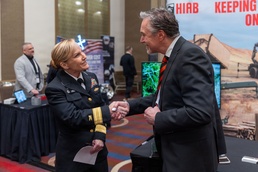
Addressing military and industry partners in Pittsburgh on Feb. 25, Navy Rear Adm. Julie Treanor, commander of Defense Logistics Agency Weapons Support (Columbus), said it is “absolutely vital that we evolve in parallel with the ever-changing landscape.”
This call for evolution comes amid a seismic shift in military acquisition, driven by the demands of a contested logistics environment.
“The theme is really about change,” Treanor said to a full room at the annual National Defense Industrial Association’s Tactical Wheeled Vehicles Conference about the push to promote competition, reduce bureaucracy and expedite the delivery of capabilities to warfighters.
Treanor was one of nearly a dozen military leaders speaking on the transformation of the tactical wheeled vehicle fleet.
No other service is turning things on its head more than the Army.
“This is the most significant modernization in 40 years,” said Jeremy Brown, chief of Acquisition Integration and Programs, Deputy Assistant Secretary of the Army for Defense Exports and Cooperation. “The Army is decisively embracing a modular, open systems approach that delivers capabilities at the speed of relevance through continuous transformation.”
Army Col. Eric Anderson, Army G8, Capability Development Sustainment, echoed that sentiment. “The Army is now building specialized divisions and formations where not everything is going to be ‘dressed right’… and that’s a little bit of a different strategy than we’ve had in the past," he said of the nature of change from the ‘one-size-fits all’ paradigm to holistic support in the defense acquisition landscape over the past year. To keep pace with the Army and the other Services, DLA is driving its own transformative efforts.
“We’re reorganizing to match the speed and integration that the Services require of us,” Treanor said. Treanor said these changes are designed to deliver faster, more reliable and more cost-effective support to the Joint Force and to align with the Secretary of War’s priorities.
At the core of DLA’s transformative efforts is the new major subordinate command, DLA Weapons Support, which integrates the former Land and Maritime and Aviation missions into a single entity to provide seamless support and a unified demand signal to industry.
Treanor emphasized that DLA Weapons Support’s transformation is intended to break down silos between functions, leading to better alignment of resources and faster delivery of capabilities to the warfighter. “To manage this evolution, DLA Weapon Support’s internal structure is being designed for dual focus,” Treanor explained. “While our customer operations teams are deeply integrated with the services, our supplier operations teams align directly with our industry partners. This dual focus and the cross-communication and exchange of valuable information drives procurement efficiencies.”
Treanor said this unity of effort involves bridging DLA Weapons Support’s internal stovepipes to present a single, coordinated voice to both the new MSC’s military customers and industry partners.
“It is especially powerful when this dual focus is tailored to a specific platform based on service priority, in alignment with our national priorities, and in support of our defense,” she said, noting a recent successful alignment between DLA’s customer and supplier operation teams, industry, and the Army in supporting its Infantry Squad Vehicle lifecycle requirements.
“The ISV is a model of what we can achieve when we work together,” she continued. “Staying connected with our partners allows us to keep pace not only with the Army’s transformation, but also with the complex changes that are happening across multiple supply chains and within every single service.”
Becoming involved earlier in weapon systems lifecycles and data sharing provides DLA Weapons Support an effective pathway to more accurate and robust provisioning, Treanor said.
“Our goal, and the focus of our collaborative efforts, is to create secure ‘translation layers’ or data exchange platforms so that the data is not only shared but is also actionable and trusted by all parties,” she said. “It’s a journey, but it’s one we are fully committed to because it is the foundation of the intelligent, end-to-end supply chain we are all trying to build.”
Treanor stressed that by engaging early, DLA Weapons Support is embedding sustainment into the DNA of a program from the very beginning which allows the MSC to work with the Marine Corps Program Executive Offices, the Army Portfolio Acquisition Executives and industry partners, to identify the parts, secure the technical data, and build a supply chain before the system hits the field at scale.
“We can’t do our job without working with DLA,” said Jennifer Moore, Marine Corps program manager for Light Tactical Vehicles, of DLA’s critical role in being the intermediary between the Services and industry. “We have a remarkable relationship … with our DLA weapon systems support managers’ insights and the reach that they have into industry as it far exceeds our ability.”
Treanor said these efforts ensure DLA Weapons Support remains resilient and agile and is prepared to meet all future challenges in support of the Joint Force.
The Tactical Wheeled Vehicles (TWV) Conference has been a pivotal event for the tactical wheeled vehicle industry, bringing together leaders from the Department of War, military services, industry, prime contractors, subcontractors, suppliers, and academia. It has played a crucial role in addressing the present and future requirements of tactical wheeled vehicles, providing a unique atmosphere for open discussion on military needs.