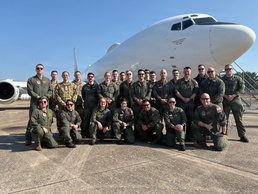
KEESLER AIR FORCE BASE, Miss. - U.S. Strategic Command’s Airborne Command Post, known as “Looking Glass,” conducted a two-day visit to Keesler Air Force Base Feb. 12–13, emphasizing to service members in training the importance of joint command and control operations and strategic deterrence.
The Looking Glass mission serves as the nation’s ultimate insurance policy, providing an airborne nuclear command, control, and communications (NC3) capability that ensures the President and senior military leaders can direct U.S. strategic forces if ground-based command centers are compromised.
“There is a misconception in thinking that, because we have not detonated a nuclear weapon in decades, that we do not use them,” said U.S. Air Force Master Sgt. Paul Ewing, USSTRATCOM Command Centers Division standards and evaluation section chief.
“The truth is that the U.S. nuclear enterprise is a daily reminder to potential adversaries of liberty that today would be a bad day to start a fight,” Ewing added.
Operating from the U.S. Navy E-6B Mercury aircraft, Looking Glass maintains continuous readiness through a combination of airborne and ground alert operations, supported by in-flight refueling and hardened communications systems designed to function in the most extreme conditions.
During the visit, Looking Glass warfighters engaged with command and control operations and cyber students, highlighting how the skills they are learning in the classroom directly translate to real-world joint operations across the Department of War.
U.S. Navy Lt. Ryan Williams, Fleet Air Reconnaissance Squadron (VQ) 4 flight officer, said students can see firsthand that it is not just a theoretical hierarchy, but a real system that makes a significant impact on NC3.
“It highlights the joint nature of the U.S. Strategic Command, with multiple services working together on a nuclear platform, particularly the Navy personnel and the significant Air Force presence supporting the Looking Glass mission,” Williams said.
A key capability discussed during the engagement was the Airborne Launch Control System. This unique function of the Looking Glass mission allows airborne battle staff to remotely launch the Air Force’s land-based intercontinental ballistic missiles if ground-based launch control centers are rendered inoperable.
“Engaging with command and control Airmen in training at Keesler is paramount because it ingrains in them the fundamental nature of their mission as critical links in the nuclear enterprise,” Ewing said. “They are the first human link in proving the credibility, capability and will that prevents the failure of nuclear deterrence.”
Since its inception in 1961, the Airborne National Command Post mission has evolved to meet changes in technology, threats and the strategic environment, while maintaining its core responsibility of ensuring an unbroken chain of command under any conditions. While the continuous alert ended in 1990, Williams said the responsibility for the Looking Glass mission continues to adapt as needed.
“While the mission itself has remained constant, continuous modernization has significantly enhanced the platform’s communications and data processing capabilities, allowing faster operations and more seamless integration across the nuclear enterprise,” Williams said.
By connecting classroom instruction with operational experience, the visit reinforced the role Keesler- trained Airmen play in supporting joint command and control operations and sustaining the nation’s strategic deterrence mission, ensuring they are prepared to operate in complex and contested environments throughout their careers.