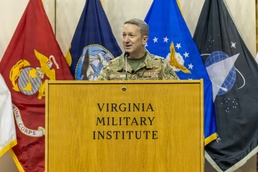
The nation’s top Army ROTC cadets convened for the 51st George C. Marshall Leadership and Awards Seminar held Feb. 23-24, 2026, at the Virginia Military Institute in Lexington, Virginia.
“You are here in recognition of your leadership excellence; of your talent and your accomplishments during your time in ROTC, but more importantly this is about your potential,” said Brig. Gen. Maurice Barnett, commanding general of U.S. Army Cadet Command, addressing the top 5% of Army ROTC cadets in the nation.
The two-day event honors General George C. Marshall’s legacy as a distinguished Citizen-Soldier, offering cadets unique opportunities and interactions with military senior leaders, defense experts, and peers in both large and small group discussions.
“It’s about immersing ourselves and understanding who General Marshall was, what he meant to our Nation as a Soldier and a statesman, what you can gain from him and how to apply the wisdom he left us,” said Barnett.
Gen. Dan Caine, Chairman of the Joint Chiefs of Staff and an alumnus of VMI, spoke to cadets about General Marshall’s legacy and congratulated them on the prestige of being selected to attend the Leadership and Awards Seminar.
“When I was a cadet here, I worked the Marshall Awards as we received more than 300 of you … and I remember then as we were handing out books and checking into hotel rooms, that I could not be more impressed with the quality of human that was walking through the door to be a Marshall award winner,” Caine recalled.
“It was striking to me then, and it is striking to me now how lucky we are to have you entering the Joint Force. Remember that as you finish up today and give your commission, the job is just getting started.”
He offered up words of wisdom, experience, and advice as the cadets prepare to commission and enter their roles as officers and community leaders.
“Your path in service will not always be easy; you will be tested, you will be challenged, you will be asked to make tough decisions,” Caine said.
“From time to time, you will find yourselves at a crossroads where you simply don’t know what to do. You’ll wonder: How do I solve this incredible problem? What do I do in this situation that I don’t know what to do? What are the elements of this decision that I can’t even begin to get my head around? I encourage you, at that point in time, to ask yourself– as I have literally hundreds and hundreds of times in my life – ask yourself the question: What would Marshall do?”
Cadets had opportunities to hear from and inquire with senior leaders about topics ranging from modern warfare, work-life balance, and the future of, not only the Army, but the Joint Force.
Cadet Connor Cornwell, a Green-to-Gold cadet at Austin Peay State University, felt humbled to be selected as an attendee and “part of the elite percentage of cadets.”
“We have different echelons of leaders, like George C. Marshall, that came before us and shared their experiences,” Cornwell said. “I’m taking all of that information and using it to build relationships with my peers so I can learn from lessons past and use that to implement and develop my leadership style.”
Cadet Patrick Sheats, a senior at Texas Christian University, enjoyed the exposure to senior leaders that he and his peers don’t typically get within their programs.
“It’s really inspiring to get to hear from the Generals of the United States of America how far that selfless service mentality goes, and it reminds me a lot of my faith,” Sheats said.
“It’s exciting to realize we’re stepping into a profession that not everyone is able or chooses to do.”
This year’s seminar marked a return to the Virginia Military Institute, where the legacy of Gen. George C. Marshall began and is still shared today.
Cadets in attendance appreciated the opportunity to congregate with peers from across the country in a shared space and engage in thought-provoking discussions about leadership at all levels.
“This event offers the ability to work with outstanding cadets and see what people’s intentions are in their future careers while engaging with and learning from leaders who have excelled in their military careers,” said Cadet Matthew Kleinschuster, a senior at the Virginia Military Institute.
“My main goal is to meet people here that I’m going into the career field with and I’m excited to build up those relationships.”
In the end, the Army ROTC cadets will depart from the event with a stronger concept of the lessons and character of those that led before them, as well as a deeper understanding of their leadership expectations as 2nd Lts. in the Army.
“Understand the value of having leaders like [retired] General Brito, General Davis, or General Caine coming in to invest their time and don’t waste this opportunity because it’s critically important to your maturation,” Barnett said.
“At the end of the day, you’re all going to do the same thing regardless of where you commission or what the path was. You’re all going to serve the Nation.”
U.S. Army Cadet Command is America’s largest commissioning source that produces over 5,000 2nd Lts. annually into all three service components including Active Duty, Army National Guard, and Army Reserve as part of U.S. Army Recruiting Command’s officer force generation pipeline.