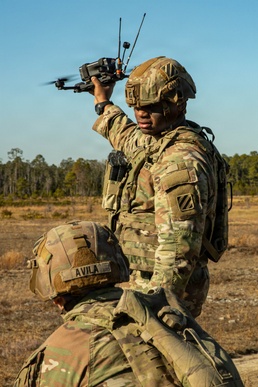
FORT STEWART, Ga. — The 3rd Infantry Division is ensuring its Soldiers do more than just acquire and field test new equipment — they are building the skills and mentality to effectively employ new technology to solve problems and win on the battlefield of the future. This innovative and forward-thinking mindset was at the forefront of 2nd Armored Brigade Combat Team’s (2nd ABCT) annual training exercise Spartan Focus conducted throughout Fort Stewart from Jan. 26-Feb. 20, 2026. One of the main focal points of training was operator qualification across multiple unmanned aircraft systems (UAS) as part of Transforming in Contact 2.0 (TiC) – an Army-wide initiative that emphasizes not just fielding emerging technologies, but ensuring every Soldier is proficient enough to employ them in real-world conditions. "Innovation doesn't stop at tanks and weapon systems; it plays a role in every aspect of the battlefield," said U.S. Army Maj. Patrick Smith, the 703rd Brigade Support Battalion (BSB) executive officer. Central to the brigade's headware development was UAS operator qualification training with 6th Squadron, 8th Cavalry Regiment (6th Sqn., 8th Cav. Regt.), 2nd ABCT. Soldiers conducted Table VI, a live-fire crew certification event, training on reconnaissance platforms, building the operator proficiency needed to underpin the unit's principle of 'see first, decide first, strike first, win.' "UAS is important on the modern battlefield today, because it is a very fast-paced battlefield, and the faster you can receive information and sense the enemy, the faster you can react, and whoever reacts first wins," said Capt. William Langley, a company commander assigned to 6th Sqn., 8th Cav. Regt. 1st Lt. Declan McKeown, the UAS platoon leader, said operator certification is what converts a capable system into a tactical advantage. "The enemy wants to find us first, so it's a competition between the enemy and us to utilize our systems to be able to sense, track and maintain tactical advantage," McKeown said. The certification push extended beyond dedicated drone units. Medics with the 703rd BSB were trained and certified to independently launch, fly and land the Tactical Resupply Vehicle (TRV)-150 – a heavy-lift drone capable of carrying up to 150 lbs of supplies at roughly 67 mph across 43 miles. "The 703rd is known as the beating heart of Sparta, and we're living up to our nickname in the field exercise," Smith said. "Our medics have been trained and certified in launching, flying and landing it." Those newly certified medics operated the TRV-150 to transport blood across three training locations at Fort Stewart, compressing what would have previously required a ground or helicopter evacuation into a precision aerial delivery. The system transported payloads 600 feet above the terrain at approximately 70 mph, delivering blood directly where it is needed. "We're trying to find methods that are survivable, that are precise and that are responsive to the Soldiers that are on the front line," Smith added. For 1st Lt. Edgardo Rivera Marcano, 2nd ABCT's medical supply officer, training medics to operate the system independently represents a deliberate expansion of the brigade's collective operator skill set. "Not only is it important to know how this system operates, but how we load and unload while we're using it as a payload platform," Rivera Marcano said. "The medics need to know how those classes are supplied, how they are loaded, how they operate, and what the capabilities are of the system we are using." Previously, medical evacuation relied on ambulance backhaul — a method Rivera Marcano said would not meet the tempo demands of large-scale combat operations. "Now, those operations would not be in a timely manner, so innovations like this would facilitate how we deliver care and supplies to people on the front lines," he said. As the Army's leading TiC 2.0 unit, the 3rd ID continues to advance the idea that fielding hardware and building the human skills to employ it are not separate tasks, but two sides of the same mission — a lesson Spartan Focus 2026 put into practice across the force.