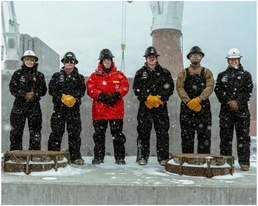
Adm. Steve Koehler, commander, U.S. Pacific Fleet, visited New Zealand and Antarctica, Feb. 10-15, 2026, to strengthen the long-standing partnership between New Zealand and the United States and to visit the Joint Task Force-Support Antarctica (JTF-SFA) service members who work year-round to safeguard national security interests by ensuring the continent remains protected and reserved for peaceful purposes.
While in Antarctica, Koehler met with U.S. National Science Foundation (NSF) officials to understand the valuable research the agency conducts in the world’s harshest environment in support of the U.S. Antarctic Program (USAP). USAP’s goals are to support the 1959 Antarctic Treaty, foster cooperative research with other nations like New Zealand, protect the Antarctic environment, and develop measures to ensure equitable and wise use of resources.
The NSF and USAP are proudly supported by JTF-SFA military personnel from the U.S. Air Force, Army, Coast Guard, and Navy deployed in support of Operation Deep Freeze. The mission provides airlift, sealift, emergency response, port cargo handling, and transportation to personnel assigned to the research stations and demonstrates the U.S. military’s commitment to supporting research programs conducted for the betterment of all humanity.
Koehler visited with service members and personnel assigned to McMurdo Station, Ross Island; and Amundsen-Scott South Pole Station, at the geographic South Pole. He spoke with Seabees from Naval Mobile Construction Battalion 3, homeported out of Port Hueneme, California, and Sailors from Navy Cargo Handling Battalion 1, homeported out of Williamsburg, Virginia, and the only active-duty cargo handling battalion in the Navy. Koehler acknowledged the tremendous construction work that the Sailors are completing in the coldest, windiest, and most inhospitable location on the planet. The Seabee detachment is currently building a permanent loading pier to replace ice piers that will enable the sealift of 80% of the essential supplies, food, and fuel needed for year-round operations at the research stations.
Koehler acknowledged Operation Deep Freeze as a critical mission executed by well-trained and ready professionals – making the extremely difficult, in the most austere environment, look routine and easy.
While in Christchurch, New Zealand, Koehler toured the Air Force Museum of New Zealand alongside Lt. Gen. Laura Lenderman, deputy commander, U.S. Pacific Air Forces. The two leaders paid respects and placed poppies at the Roll of Honour for two Royal New Zealand aviators who died while flying on a joint strike mission with the U.S. Navy in May 1944, during World War II.