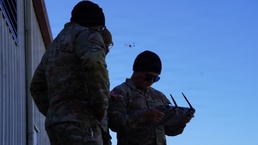
BOLESŁAWIEC, Poland - The rapid growth of small, unmanned aircraft systems (UAS) at every level of the Army has crowded low-altitude airspace, requiring units to safely deconflict thousands of Group 1 and Group 2 drones with rotary-wing attack and lift aircraft during large-scale combat operations. As ground forces rely on these systems for persistent reconnaissance and fires integration, the challenge is to maximize their use without compromising the safety of manned aviation or hindering mission tempo.
Task Force Brawler, the aviation task force of the 3rd Combat Aviation Brigade currently in rotation at Mihail Kogălniceanu Air Base (MKAB) in Romania, has developed a tailored airspace management plan for its role as the aviation support element in Combined Resolve 26-07, the European Command culminating training event. The plan supports Gray Wolf Brigade from Zagan, Poland, by incorporating the brigade’s small UAS operations while integrating attack and lift rotary-wing missions in the same airspace.
Maj. Grant Fath, operations officer for Task Force Brawler, described the plan’s core purpose:
“We know that persistent UAS coverage is critical. When we look at Ukraine and the rapid proliferation of small UAS, it is clear that ground forces must be able to use these systems effectively. At the same time, there are defined periods when rotary wing aviation must operate, so the plan focuses on safely integrating rotary wing aircraft and small UAS within the same airspace.”
The Army published foundational guidance on this issue in September 2025 with Center for Army Lessons Learned Handbook No. 25-14, 'Small Unmanned Aircraft System Airspace Management and Control: A Handbook for Army Leaders.' The 34-page document, drawn from Transformation in Contact exercises and combat training center rotations, establishes procedures for integrating small UAS with manned aircraft and fires. It emphasizes procedural controls, altitude blocks, restricted operations zones and airspace coordinating measures, over positive control because communications are often limited in contested environments. Brigade-level Air Defense Airspace Management/Brigade Aviation Elements coordinate these measures through the Airspace Control Order and unit airspace plans.
Task Force Brawler’s plan builds directly on that guidance while introducing a Soldier-centric innovation that makes doctrine far more executable at the tactical edge. Drawing from Maj. Fath’s prior experience as a brigade aviation officer for the 1st Brigade Combat Team, 3rd Infantry Division, during Combined Resolve 25-01, the plan uses a simple green-amber-red color status system. Green status allows small UAS operations from the surface to 500-feet above ground level when no rotary-wing traffic is planned. Amber status permits lateral deconfliction around planned air corridors. Red status grounds all small UAS only for emergencies or dynamic re-tasking. This color-coded construct addresses a key gap in existing guidance: the cognitive burden on non-pilot operators, often former infantrymen, and manned aviation crews operating in high-density, time-sensitive scenarios. It prioritizes procedural controls for jamming resistance and ensures share understanding, so ground forces gain maximum UAS utility without compromising pilot safety.
“We can do this safely. Small UAS and rotary-wing aircraft can operate in the same area at the same time when proper procedures are in place; this is not an unsolvable problem. With proper coordination and controls, we can safely integrate both capabilities into our airspace. Safety is a balancing act, and it is paramount to our mission,” Fath said.
The plan will undergo rigorous testing during the April 2026 Joint Multinational Readiness Center rotation, also known as JMRC, where the full exercise will stress deconfliction amid robust opposing forces, degraded communications and mixed manned-unmanned operations. Hands-on training with Ukrainian small UAS experts, widely regarded as the world’s most experienced practitioners, will inject real-world feedback to refine procedures and uncover efficiencies not visible in U.S. only training.
“No force in the world likely has more real time experience with small UAS operations than the Ukrainians. The Russia Ukraine conflict offers valuable insight into how we can better employ both small UAS and rotary wing aviation to maximize the effectiveness of our capabilities,” Fath said.
This bottom-up innovation has clear impact across the broader Army. A similar framework proved effective with Raider Brigade last year, and Gray Wolf Brigade is now adapting it with refinement, proving scalability from one rotation to the next. By capturing lessons on operator situational awareness, communications down to the individual level, and basic survivability measures such as camouflage and dispersion of forward arming and refueling points, the effort directly informs Army-wide tactics, techniques and procedures.
The effort also contributes to ongoing doctrine development. With no formal program of instruction yet established for large scale small UAS employment, rotations such as Combined Resolve serve as critical proving grounds for refining tactics and procedures. As units continue experimenting with integration and employment methods, leaders are helping shape emerging doctrine, contributing lessons learned that may inform how the Army formalizes the future use of small UAS across formations.
These contributions align squarely with the Army 2030 vision, which calls for divisions and brigades equipped with hundreds of unmanned systems integrated into multi-domain operations. Army 2030 emphasizes human-machine teaming, contested airspace dominance and transformation in contact to ensure forces can fight and win against peer adversaries. Task Force Brawler and the 3rd Combat Aviation Brigade are delivering solutions that will keep Army aviation safe, effective and dominant in the congested skies of large-scale combat. Their work accelerates the service’s transformation, ensuring that by 2030 soldiers operate with the integrated air-ground advantage required to prevail.