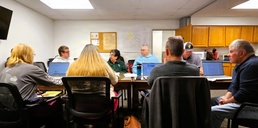
Fort McCoy personnel once again provided updates about the installation’s natural resources-related efforts Feb. 9 during the February 2026 meeting of the Monroe County (Wis.) Natural Resource and Extension Committee.
The monthly committee includes members Nodji VanWychen, Joey Esterline, Cedric Schnitzler, Doug Rogalla, Todd Sparks, and Paul Zastophil from areas within the county. According to the Monroe County webpage for the committee at https://www.co.monroe.wi.us/government/county-board-of-supervisors/boards-committees/natural-resource-extension/-folder-2344, the committee has a diverse mission.
“The mission of the Monroe County Natural Resource Committee is to manage, conserve, and protect our natural resources,” the website states. “The committee will facilitate wise, sustainable land use and outdoor recreation through information and education while supporting technical and financial assistance to landowners of Monroe County and encourage all residents of Monroe County to be stewards of our natural resources keeping in mind the generations to follow.”
As part of Monroe County, Fort McCoy has a part in supporting the committee. The post does so through the Fort McCoy Directorate of Public Works Environmental Division Natural Resources Branch (NRB) as well as the Fort McCoy Public Affairs Office.
During the February meeting, NRB Fisheries Biologist Steve Rood served as one of the Fort McCoy representatives where he reviewed recent accomplishments completed by NRB and related Fort McCoy personnel. The Fort McCoy Public Affairs Office discussed current news and events related to the committee.
Among those accomplishments in natural resources management Weichelt mentioned from January 2026 in the meeting were:
— In fisheries management, Fort McCoy personnel conducted one base flow water quality sampling and collected water samples from one runoff event
— Fisheries personnel also monitored winter thermographs to analyze stream temperatures and collected temperature and dissolved oxygen readings on 10 lakes. Oxygen is nearly optimal for all lakes. Ice thickness during the middle of the month was less than average for January due to warm temperatures and rain. However, ice thickness increased the last half of the month in response to sub-zero temps.
— Personnel also conducted 18 creel surveys. Catch rates have been average to high, which is typical. Anglers still report catching rainbow trout on the stocked lakes. Fisheries personnel also provided anglers with life history information from fish recaptured tagged fish and coordinated rainbow trout stocking for six lakes in April 2026.
— In forestry management at Fort McCoy, personnel completed the calendar year 2025 annual after-action review of the prescribed fire program to document outcomes and improve future fire operations. They also provided technical forestry comments for multiple projects through National Environmental Policy Act review and packeted Fort McCoy’s annual burn plans and sent adjoining maps to the U.S. Forest Service to prep for burn season.
— Forestry personnel also assisted with the annual fire inspection by the fire department of the NRB storage building 782 and compiled information to purchase seedlings for Arbor Day celebration tree planting for 2026.
— In invasive species management, officials with NRB state that atarting in January the CSU invasives crew was reduced to just three FTE field crew and during the entire first week of the month, two of which attended fire training and were not available for field work. Most of the time was spent this reporting period conducting 22.6 acres of habitat shreds in D3, D4, and D6. While not counted towards invasive acre totals, 8.5 of those 22.6 acres contained glossy buckthorn. It was also cold during January, mostly staying in the single digits or negatives. On the coldest days, when backpack spraying was not advisable, effort was put towards building bluebird boxes. Finally, the John Deere shredder had mechanical issues that limited its use at the end of the reporting period.
— Invasive species personnel also provided comments on invasive species for two NEPA reviews in February, and the invasive plant management plan was sent out for a first review by stakeholders on post. It was last updated in 2020.
— NRB staff and contracted staff met with Fort McCoy Directorate of Plans, Training, Mobilization and Security personnel to discuss plans and next steps for potential invasive mapping and treatment in the NIA via drone.
— NRB staff met with WiscCorps to discuss dates for summer crews this year. Tentatively there will be a total of five crew weeks between June 29 and July 17.
— Staff met with the pest management contractor to discuss invasive plant treatments in the installation’s cantonment area for the upcoming growing season.
— During January 2026, NRB staff spent time planning for the Monroe County Invasive Species Working Group (MCISWG) Annual meeting and field trip, as well as assisting planning for a cooperative program with Spart Floral ahead of National Invasive Species Awareness Week.
— NRB officials announced the MCISWG field day at Fort McCoy will be Thursday, June 11th this year.
— In wildlife management, NRB staff started the annual review and update for the Fort McCoy Hunting, Fishing, and Trapping Rules and Regulations (FMR 420-29). Currently having other directorates review the regs and provide comments/suggestions.
— Estimated deer herd size prior to hunting seasons was at 24-25 deer per square mile, or roughly 1,800 deer on the installation.To meet the goal of 15-20 deer per square mile or 1,100-1,500 deer on the installation, the harvest goal over this fall/winter would be roughly 300-700 deer over all seasons (excluding Cant. Archery). With the close of the archery season and taking all deer harvests from the fall/winter seasons, we should have reached our overwinter goal and should be around 17-18 deer per square mile.
— NRB staff also continued with some habitat work. Shredding of woody brush that encroaching on wetlands and other sites of importance in training areas D3, D4, and D6. Shredding will allow a flush of native forbs and grasses as well as bring desirable browse species back down within reach of for utilization by deer.
— Submitted the Pesticide Use List to Army Environmental Command for approval.The PUL consists of all herbicides, fungicides, insecticides, etc. (pesticides) that would potentially be used on the installation throughout the year by all programs. Issued a couple nuisance beaver permits for infrastrycture concerns (bridges/culverts). Three beavers were also trapped.
— The recreational trapping season closed Feb. 15 at Fort McCoy. Trapping season for water-based animals (otter, beaver, muskrat) will run through March 31.
The Fort McCoy personnel who support the Monroe County committee help the entire county have its best possible support for effectively managing natural resources and supporting education for natural resources, cultural history, and more, officials said.
Fort McCoy’s motto is to be the “Total Force Training Center.”
Located in the heart of the upper Midwest, Fort McCoy is the only U.S. Army installation in Wisconsin.
The installation has provided support and facilities for the field and classroom training of more than 100,000 military personnel from all services nearly every year since 1984.
Learn more about Fort McCoy online at https://home.army.mil/mccoy, on Facebook by searching “ftmccoy,” on Flickr at https://www.flickr.com/photos/fortmccoywi, and on X (formerly Twitter) by searching “usagmccoy.”
Also try downloading the My Army Post app to your smartphone and set “Fort McCoy” or another installation as your preferred base. Fort McCoy is also part of Army’s Installation Management Command where “We Are The Army’s Home.”
(The Fort McCoy Directorate of Public Works Environmental Division Natural Resources Branch contributed to this article.)