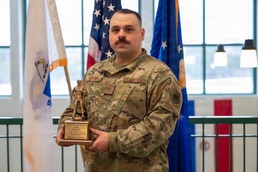
Tech. Sgt. Jacob “Stout” Hatcher, an enlisted weapons officer with the 102nd Intelligence, Surveillance and Reconnaissance Group Weapons and Tactics Flight, 102nd Intelligence Wing, Massachusetts National Guard, was one of the only noncommissioned officers selected to attend the newly merged enlisted and officer course at the U.S. Air Force Weapons School.
In 2025, the 19th Weapons Squadron integrated its separate officer and enlisted courses into a single program to address the evolving intelligence environment and the needs of the Department of the Air Force. The course develops enlisted intelligence professionals as leaders, technical experts, advisors and instructors alongside their officer counterparts under the Force Development Construct (FDC). By meeting the program’s rigorous standards, Hatcher became the sole NCO to graduate and the first enlisted intelligence weapons officer to complete the full Intelligence Weapons Instructor Course (IWIC).
Additionally, his performance in the mission planning cell earned him the Col. Laura “Hands” Berry Mission Award, presented to the top IWIC graduate who demonstrates the ability to apply theory and academics to the practical use of tactics, techniques and procedures.
“I am incredibly proud that not only is Stout the first enlisted graduate of the IWIC under the new FDC, but he also forged that path as a member of the Air National Guard and the 102nd Intelligence Wing,” said Col. Andrew St. Jean, 102nd IW commander and a graduate of the IWIC, where he also previously served as an instructor and director of operations for the 19th WPS. “The instructor cadre also recognized him as the student most capable of integrating and leading advanced mission planning to achieve combined combat effects. To win this award is impressive. To win it as an enlisted member is unprecedented. It’s hard enough for an officer student to focus officer peers on a shared understanding of a tactical problem and the range of solutions, but to do so as the lowest-ranking person at the table is a testament to his capability and character.”
The Weapons School provides graduate-level instructor training in weapons and tactics employment, offering students about 400 hours of academics and rigorous combat training missions. The school trains tactical experts and leaders to control and exploit air, space and cyber capabilities for the joint force, graduating roughly 150 weapons officers and enlisted tacticians every six months. Graduates become system experts, instructors and leaders, serving as trusted advisors to military and civilian leaders and preserving the Air Force’s tactical and operational knowledge.
The course blends academic instruction with practical application of intelligence tactics, techniques and procedures, and advanced mission planning through multiday planning cells. Stout excelled in his training missions, integrating intelligence and ISR capabilities at the tactical, theater and national levels to apply airpower against complex operational challenges.
“You can’t train determination and tenacity. Stout had those qualities in spades,” said Lt. Col. Andrew West, 19th WPS commander. “Leveraging his extensive real-world ISR experience and technical expertise, Tech. Sgt. Hatcher proved to be an exceptional performer at the IWIC. Despite initial knowledge gaps in unit-level intelligence, his remarkable determination, tenacity and humility were key to his success. Every intelligence student shows up to IWIC as an expert in one or two mission sets. To graduate from the 19th WPS, you have to push yourself to master the knowledge and application of intelligence and ISR to all of the Air Force and Joint Force’s missions. He proactively sought and applied feedback from instructors and peers, demonstrating a strong motivation to achieve that incredibly high standard.”
The U.S. Air Force Weapons School Graduate Patch represents a monumental achievement for enlisted Airmen. Worn on the left sleeve of the uniform, it serves as a symbol of advanced tactical expertise, professional excellence, and credibility. This distinction identifies Airmen who have demonstrated the knowledge, judgment and leadership required to advise and influence military leaders at every level, from tactical operations to strategic decision-making.
Hatcher said the course greatly challenged him and pushed him outside his comfort zone. His time at the 19th Weapons Squadron strengthened his abilities as an instructor and mission planner and reinforced the importance of receiving and applying feedback for growth.
“It is single-handedly the most rewarding experience I have had in my career,” Hatcher said. “Moving forward, I plan to take the lessons I learned from the course and provide tactical expertise to the unit while offering honest and direct feedback. I plan to invest in our airmen, deliver quality instruction, enhance our training programs and encourage a unit-wide commitment to continuous improvement.”