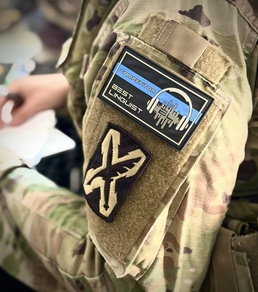
Five Illinois Army National Guard Soldiers from the Chicago-based Charlie Company, 341st Military Intelligence Battalion (Linguist), participated in the 8th Annual Best Linguist Competition (BLING) and the 37th Annual Language Conference (LANGCON), hosted by the Utah Army National Guard’s 300th Military Intelligence Brigade (Linguist) on Feb. 5-6.
The events enhance operational language capability, strengthen intelligence tradecraft, and support mission readiness across the defense language enterprise. The Soldiers — Sgt. Yuriy Slyvka (Russian), Sgt. Shahim Paiman (Persian-Farsi), Cpl. Mohanned El Natour (Arabic), Sgt. Ibeeth Garza (Spanish), and Sgt. Kamilath Ali (French) — competed as a team against participants from across the Department of Defense and defense language enterprise in a competition testing linguistic proficiency and operational intelligence skills in a simulated operational environment.
Competitors rotated through scenario-based events replicating real-world intelligence requirements, including open-source intelligence collection and analysis, document and media exploitation, voice intercept transcription and translation, and intelligence reporting and briefing under time-constrained and operationally realistic conditions. Cpl. El Natour placed in the top 20 percent of Arabic linguists in the top half of linguists overall. Sgt. Slyvka ranked in the top half of Russian linguists and in the top 40 percent of linguists overall.
Following the competition, the Soldiers attended the 37th Annual Language Conference, which brought together members of the defense language enterprise, academia, and industry to discuss current and emerging challenges facing intelligence linguists. The conference provided training, professional development, and collaboration opportunities focused on sustaining language readiness and supporting operational intelligence requirements.
Illinois Army National Guard participation in BLING and LANGCON reinforces the development of language-enabled intelligence capabilities and supports continued readiness to meet state, federal, and global mission requirements.