NAVAL STATION NEWPORT R.I. --- In a strategic move to enhance the core competencies of the Navy’s Surface Warfare Officers, Surface Warfare Schools Command (SWSC) ushered in a new era of maritime training with the establishment of the Mariner Skills Training Centers (MSTCs). The MSTCs, one located in San Diego, California (MSTCPAC) and the other in Norfolk, Virginia (MSTCLANT), are state-of-the-art facilities and represent a significant investment in the professional development of our Sailors. The creation of these centers was a direct result of the Vice Chief of Naval Operations' Surface Force Comprehensive Review, which identified critical gaps in seamanship and navigation skills following the fatal collisions involving the USS Fitzgerald and USS John S.McCain in 2017.
The MSTCs were formally established on October 1, 2020, to provide comprehensive mariner training, equipping sea-bound warriors with the shiphandling and navigation skills necessary to fulfill the Navy's mission of maintaining global maritime superiority. This initiative marked a pivotal shift in the Surface Warfare community's approach to training, moving towards a more hands-on, technologically advanced, and continuous learning model.
The evolution of training at the MSTCs has been marked by a significant increase in rigor and realism.Prior to the establishment of the centers, Surface Warfare Officer (SWO) training involved approximately 300 hours in bridge simulators. Today, that number can be expected to total over 800 hours, a testament to the Navy's commitment to providing extensive, high-fidelity simulation. This progression reflects a move away from a model that often equated "on the job training" with competence, to a rigorous, competency-based assessment system.
This new paradigm is built on a foundation of standardized courses and formal "https://goto.google.com/no-go" shiphandling assessments at critical career milestones. New courses have been introduced, including a six-week Officer of the Deck (OOD) Phase 1 course following the Basic Division Officer Course (BDOC), and a three-week OOD Phase 2 course after the Advanced Division Officer Course (ADOC).
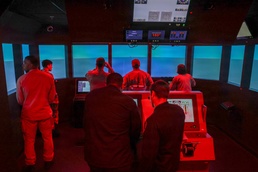
At the heart of the MSTCs are their advanced simulation capabilities.Both MSTCPAC and MSTCLANT are equipped with a suite of cutting-edge trainers, including Navigation, Seamanship, and Shiphandling Trainers (NSSTs), Conning Officer Virtual Environments (COVEs), full-mission bridge simulators, and bridge wing simulators.
This technology allows for the replication of a wide range of challenging and realistic scenarios that officers may face at sea, from high-density traffic situations to complex navigational exercises.Instructors can even recreate past mishaps to provide valuable learning experiences.
This ensures that graduates are not just familiar with the concepts but are confident and competent in their application.
The establishment and progression of the MSTCs have had a transformative impact on the readiness of the Surface Force.The Surface Warfare community has been able to significantly increase junior officer shiphandling simulator hours, providing a substantial boost to their practical experience before they even step onto a ship. This investment of hundreds of millions of dollars to modernize the training centers in San Diego and Norfolk underscores the Navy's commitment to this vital training.
The hands-on training from seasoned maritime experts, including retired commanding officers and experienced civilian master mariners, provides invaluable insights and mentorship.
The MSTCs are more than just training facilities; they are a strategic investment in the future of the Surface Warfare community. By providing Sailors with the most advanced training tools and a rigorous, standardized curriculum, we are ensuring that the U.S. Navy remains the world's preeminent maritime force. The skills and confidence instilled at the MSTCs will pay dividends for years to come, producing a generation of highly proficient and professional mariners.
The expertise of the instructors at SWSC and the MSTCs, combined with the cutting-edge technology, are forging a new standard of excellence in surface warfare. The officers who graduate from these centers will be ready to meet any challenge and lead our Navy to victory in the complex maritime environment of the 21st century. The MSTCs will continue to evolve, incorporating new technologies and training methodologies to ensure that our Sailors always have the advantage.
The dedication of the MSTCs pays homage to two legendary figures in the Surface Warfare community. MSTCLANT is named "Rinn Hall" in honor of the late Capt. Paul X. Rinn, who heroically saved the USS Samuel B. Roberts (FFG-58) after it struck a mine in 1988. MSTCPAC is dedicated to retired Capt. Bud Weeks, a revered figure with over 50 years of experience as a SWO and mariner skills instructor at SWSC Newport, whose name is synonymous with excellence in seamanship.
To keep up with updates, follow SWSC on social media.