Forty years to the day after launching his illustrious federal career, Dr. James H. Newman officially retired from the Naval Postgraduate School (NPS), Dec. 8, 2025.
The former NASA astronaut wore many hats over his years of service to the NPS community, including serving twice as acting provost, the only person in NPS history to do so. Beginning his NPS career as a NASA visiting professor, Newman served as a longtime professor in the Space Systems Academic Group (SSAG), including almost eight years as its chair.
During his time on campus, regardless of title or role, one unifying theme is clearly evident — an absolute dedication to NPS mission, students, and faculty.
NPS president retired U.S. Navy Vice Adm. Ann Rondeau recognized Newman’s many years of service and impact at the Fall Quarter Graduation ceremony in December.
“Jim Newman’s career may be defined by his pioneering work as a NASA astronaut and scientist, and his impact on hundreds of NPS students as he guided them through the rigors of their graduate studies,” said Rondeau.
“For all who know Jim, he is first and foremost a man of exemplary character and integrity,” she continued. “In his presence, we are all inspired to be our best, which is the essence of great teaching and leadership. On behalf of the Naval Postgraduate School, thank you Jim for all you have done for NPS, our Navy, and nation.”
“Throughout his tenure at NPS, Dr. Newman made a generational impact on students, faculty, and staff,” added Dr. Wenschel Lan, current SSAG chair. “His engaging and thought-provoking approach to teaching orbital mechanics and other space systems courses left a lasting impression on countless naval, joint, and foreign military officers, as well as government civilians.”
“Across campus, his mentorship and leadership — as professor, chair, and provost — fostered a culture of collaboration, trust, and service to mission,” she added. “We are truly grateful for Dr. Newman’s many years of service and his enduring commitment to the NPS mission.”
When Newman arrived at NPS in 2006 as a NASA visiting professor, he brought with him a wealth of experience. Joining NASA in 1985, he entered the astronaut training program in 1990.
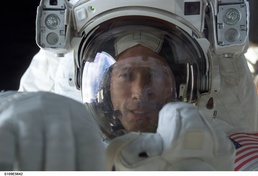
Newman’s spaceflight experience included four missions aboard the Space Shuttles Discovery (STS-51), Endeavour (STS-69, STS-88), and Columbia (STS-109), logging more than 17 million miles, 679 Earth orbits and 43 days in space, including the first International Space Station assembly mission and six space walks. And on one of those spacewalks, he installed mission-critical equipment on the International Space Station and another, equally critical repairs to the Hubble Space Telescope.
His office assignments at NASA included progressively more responsible positions in leadership and management, culminating in his assignment as director of NASA’s Human Space Flight Program, Russia.
Newman’s academic life began at La Jolla High School in San Diego, California, then earned his Bachelor of Arts degree in physics from Dartmouth College in 1978, and his Master of Arts degree and a Doctorate in physics from Rice University in 1982 and 1984, respectively.
His space and academic career came together when he arrived at NPS in 2006, and in 2008, he officially transferred from NASA to the Department of the Navy to accept a tenure-track position as a professor at NPS.
In addition to physics, Newman’s areas of expertise he brought to NPS from NASA included orbital mechanics and launch systems, payload design, and programming for space applications. He saw the potential in small satellites, or CubeSats, very early on, and guided applied NPS student research on countless projects of naval and national interest while simultaneously providing students with opportunities for hands-on research and education.
This applied research has included launching several small satellites and satellite deployers, and he is currently assisting with payload research for satellites in development by other faculty in SSAG.
“I would say that as a professor I am unabashedly positive about the whole experience,” Newman said. “It has not always been easy, but neither was NASA. Going to space is really hard, but it's a lot of fun. The same thing has been true here. There has been a lot of hard work, but with a lot of camaraderie and accomplishment.”
“I’ve also had the ability to get into new projects, programs, and educational experiences with students, such as the high-altitude balloon program, high-power rocket program, and CubeSats and CubeSat launchers,” he continued. “All of this we did as a team.”
Working with NPS students is to be at the “tip of the spear,” Newman said. Inculcating critical thinking skills is crucial as they go on to become senior officers, field grade officers, CNOs or even SECNAVs.
NPS students are very different than those at civilian institutions, he continued. Typically older, mid-career military officers, they bring real world experience from the fleet to the table as well as intellectual curiosity and a desire to learn more. They are focused, directed, and very interested in impact and relevance.
“They often say ‘I saw this problem there; can I do something about it while I’m here?’” Newman said. “NPS students are a real treat to work with!”
This sentiment is reciprocated by his students, according to former student Marine Corps Maj. Dillon Pierce, SSAG Research Assistant Professor, who earned his master’s in space systems operations from NPS in June 2019 and his doctorate in astronautical engineering from NPS in June 2025.
“Dr. Newman has had the single greatest impact on my development at NPS and continues to be one of the most influential people in my life,” he said. “He taught me how to think rigorously, challenge assumptions, and design for real-world complexity rather than convenient solutions. Beyond the classroom, he has invested deeply in me personally and professionally, showing up to field tests in the desert, ensuring I had the resources to succeed, and consistently pushing me to grow. I’m forever grateful for his mentorship, which has shaped not only the engineer I’ve become, but the person as well.”
Newman has also been a staunch proponent and supporter of his fellow NPS faculty. Having a very relevant and vibrant faculty enables NPS to meet its mission of educating students and conducting research, he says. As an administrator, Newman’s service in academic leadership is about maximizing opportunities while minimizing “administrivia,” he says, the necessary bureaucracy of federal service.
“Our responsibility – I really felt this as provost – is doing what we can to enable our faculty to really have the opportunity to do their work, providing educational and research opportunities to the students,” Newman said. “Without really great faculty, the best students can wither.”
Newman says, emphatically, that one of the highlights of his NPS career has been mentoring junior faculty. In June 2024, when NPS president retired Vice Adm. Ann E. Rondeau asked Newman to return to the post of acting provost, a position he held years earlier, he agreed, knowing that a rising star in SSAG, Wenschel Lan, was ready to step in as acting chair. As a previous Ph.D. candidate at NPS, Lan’s success is something he takes considerable pride in.
“Having her be ready to step in and be the chair, seeing her succeed, and seeing the students do well under her leadership is very, very important to me because I like to think that I’ve helped keep things going,” he said.
In federal service, leaders must always be ready to navigate uncertainty, including when defense leaders and priorities change.
“Working through hard times brings challenges and opportunities,” Newman said. “The best part is working with great people, and often that makes the hard work more valuable in the sense that I know that I’m working with people that I trust and have shared values with, and that we're doing the best we can for the institution with what we have.”
“My last year here was very much a high point for me at NPS, especially being part of President Rondeau’s leadership team, I learned so much, and I was very happy to have professor Matt Carlyle, former chair of the NPS Operations Research department, willing to become the acting provost and to have the opportunity and time to help him transition into the role.”
Newman added that through it all, the strength of the NPS community has remained a constant.
“There remains at NPS an incredibly committed faculty who come to work and apply themselves to the benefit of not just themselves and their research, but definitely to the benefit of the students in making sure they have real and important opportunities and the best teaching that we can provide,” he said.
That same sense of commitment, Newman emphasized, is something students actively share. Looking ahead, he offered the following advice for future students:
“Appreciate your time here and take advantage of it,” he said. “Lean in, get to know as many people as you can because it makes it more fun and it’s the way to get things done. While you’re relatively young, it’s a great time to apply yourself because you can learn so much at that age.”
The commitment to NPS did not end with Newman’s formal retirement. True to the advice he offers younger generations, he will continue to serve NPS and its students and faculty as a volunteer, and he also looks forward to spending more quality time with family and friends, and finally cleaning out his garage.