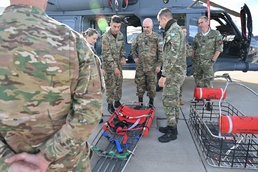
DAVIS-MONTHAN AIR FORCE BASE, Ariz.–Air Forces Southern (AFSOUTH) conducted a knowledge exchange with military representatives of the Argentine air force, Fuerza Aérea Argentina (FAA), in support of their Peace Condor program, at Davis-Monthan Air Force Base, Arizona, Jan. 6-9, 2026.
The Argentine air force’s Peace Condor program supports the integration of its six newly acquired F-16 Fighting Falcon aircraft, received in late 2025. Through mentorship from the United States, the FAA is developing the plans and programs required to operate and sustain the modern fighter platform. The addition of the F-16 enhances Argentina’s ability to defend its airspace and contribute to regional security efforts across the Western Hemisphere.
“We recently acquired F-16 weapon systems, but we currently do not have the foundational knowledge to launch the aircraft,” said Argentine air force Col. Norma Arnoletto, chief medical director. “We are very grateful for this exchange because we have gathered a lot of information to take home and alter to meet our needs, in order to best support our F-16 program.”
According to Air Forces Southern leadership, the exchange emphasized building sustainable and interoperable capabilities rather than simply transferring equipment.
“This exchange focused on building sustainable, interoperable medical and operational capabilities alongside our Argentine partners as they integrate the F-16,” said U.S. Air Force Lt. Col. Aaron Goodrich, Air Forces Southern deputy command surgeon. “By sharing aerospace medicine expertise, best practices and lessons learned, we’re helping improve pilot safety, strengthen mission readiness and reenforce long-term regional security across the hemisphere.”
During the knowledge exchange, AFSOUTH connected the FAA delegation with subject matter experts across multiple mission areas, including infrastructure, weapons systems and aerospace medicine, to support the development of a comprehensive and sustainable F-16 program.
The 305th Rescue Squadron (RQS) showcased its combat search and rescue (CSAR) capabilities, which play a vital role to an F-16 program by supporting pilot survivability, mission effectiveness and strategic decision-making. Many F-16 programs rely on integration with allied CSAR forces to ensure rapid response during contingencies.
“It’s important for the FAA to know what capabilities we have, so they can compare and grow their capabilities,” said U.S. Air Force 1st Lt. Lee Fowler, 305th RQS rescue pilot. Fowler also said he’s happy to see such a strong partnership with the FAA and U.S. Air Force because it not only advances medical capabilities but strengthens interoperability and stability in the Western Hemisphere. Because of the F-16’s high-performance flight profile, aerospace medicine was a key focus area during the exchange. Flight doctors at the 355th Medical Group also shared information and answered questions about caring for that very human weapon system. Topics discussed included physical therapy, medical standards and in-flight emergencies.
Additional expertise was provided through the State Partnership Program (SPP), which pairs the Georgia National Guard with the Argentina’s armed forces. A flight surgeon from Robins Air Force Base, Georgia, advised on aerospace medicine considerations specific to f-16 operations.
“We are helping the Argentine air force build up their aerospace medicine program, specifically looking at flight surgeons, flight medicine, tactical combat casualty care, and hydrazine recovery and mitigation with the F-16 program,” said Lt. Col. Joshua Lane, 116th Medical Group, flight surgeon and SPP representative. “The SPP and Air Forces Southern have partnered together to provide educational resources to the Argentine air force to not only build up their F-16 program but to support international cooperation with the U.S. Air Force.”
The FAA delegation also visited Morris Air National Guard Base, Arizona, where they observed F-16 pilot training conducted by the 162nd Wing.
Throughout the visit, Argentine air force members expressed appreciation for the access to subject matter experts and operational facilities.
We gained extremely valuable knowledge in pilot nutrition and diet, as well as research on hypoxia, which we don’t currently have in Argentina, Arnoletto said. Beyond the technical knowledge, this exchange strengthened our friendship even more, and that partnership is something we hope will continue to grow.
Throughout the week of engagements, AFSOUTH provided an integrated perspective on F-16 operations, reenforcing partnership, trust and a shared commitment to the success of the Peace Condor program and safety of the Western Hemisphere.