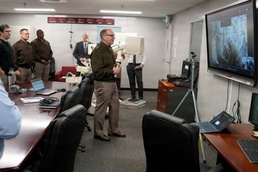
TRACY, Calif. – U.S. Army Medical Logistics Command recently showcased its telemaintenance capabilities by remotely guiding the repair of a critical imaging device in Iraq, a vital medical device for troops supporting Operation Inherent Resolve.
The successful mission, led from AMLC’s Medical Maintenance Operations Division in Tracy, or MMOD-CA, highlighted how remote support is becoming a go-to solution for complex sustainment – saving time, reducing costs and keeping personnel out of harm's way.
The device, a C-arm machine, provides real-time X-ray imaging essential for surgical procedures. When the detector on a unit in Iraq malfunctioned, rendering half the screen unreadable, it created a significant readiness issue.
From MMOD-CA, expert technicians Fernando Gonzalez-Rodriguez and Eduardo Barraza-Cardenas used video conferencing to guide the medical maintainers remotely, supporting the intricate repair and calibration procedure over two days in January.
“It was a good example of what we can accomplish using telemaintenance in lieu of sending people downrange,” said Ian McNesby, MMOD-CA’s chief of operations. “That was our first choice and usually best option, a faster way to get it done if you have a trained tech on the other end.”
The alternative was far more complex. Sending a technician to Iraq would have involved recertification training and securing an Iraqi visa, a process that can take up to 60 days.
Instead, the team embraced a technological solution, coordinating shipment of the replacement part direct to the unit, then using a training C-arm, a camera on a tripod and Microsoft Teams to guide the Soldiers through the repair.
A key factor in the mission's success was recent training completed by a biomedical equipment specialist on the other end. McNesby said the Soldier had attended a course on the C-arm at the Tracy facility just a few months prior to his deployment.
That familiarity proved crucial, especially when the team hit an unexpected snag. After the new detector was installed, the C-arm’s memory still displayed an error from the previously failed calibration procedure.
“We walked them through how to reset it, and it cleared the problem,” McNesby said, adding that the Soldiers were able to complete the final calibration on their own, restoring the C-arm to full functionality and improving the unit's medical readiness.
MMOD-CA Director Isaac Newman said the seamless repair was a testament to the direct link between remote support and strategic industry partnerships. He noted that the repair was “significantly aided by the fact that the biomedical equipment specialist on the ground had recently received manufacturer-level training” at MMOD-CA.
“This underscores our vision of establishing MMOD-CA as a premier training hub where warfighters and civilian subject-matter experts receive manufacturer-level training side-by-side,” Newman said.
He added that this collaborative model is crucial for forging invaluable working relationships between warfighters and MMOD-CA's experienced technicians.
Wes Ladlee, chief of the Maintenance Support Office for AMLC's Medical Maintenance Management Directorate, emphasized the immense time and cost savings.
“It's all about solving problems in the shortest time possible to ensure readiness,” said Ladlee, estimating a reduction of about two months compared to deploying a civilian technician.
For Newman, the success is a clear indicator of a broader strategy.
“By fostering both technical expertise and these vital professional bonds, we are enhancing the skills and confidence of our warfighters, ensuring that our forces remain ready and resilient for the future fight,” he said, “and proving that there's no distance we can't cover to support the mission.”
Operation Inherent Resolve is an established international coalition of forces in the fight against the Islamic State, created at the request of the Iraqi government. The coalition works in partnership with local forces to stabilize the region, providing air support, training and guidance to enable them to secure their own territory.
AMLC is a major subordinate command of the U.S. Army Communications-Electronics Command. AMLC delivers integrated medical logistics that enables Army and Joint Forces readiness from strategic support to the tactical edge.