FORT DRUM, N.Y. (Feb. 19, 2026) -- Fort Drum Directorate of Public Works officials are looking to improve the installation's recycling program, emphasizing that a collective effort is crucial to meet environmental goals, reduce costs, and maintain good order and discipline across the post.
While Fort Drum is close to meeting its goal of diverting 50 percent of its municipal solid waste from landfills, a recent downward trend in recycling rates has prompted a renewed push for education and personal responsibility.
Ian Crawford, DPW Environmental Compliance chief, said that the installation's system is designed for simplicity. For most personnel, it comes down to two choices: trash or recycling.
Municipal solid waste (Brown Dumpsters):everyday items not designated for recycling, such as food waste, diapers, non-recyclable packaging, etc.
Single-Stream Recycling (Blue Dumpsters):paper and cardboard, plastic bottles and cans, aluminum cans, etc.
Bulk Dunnage:Items like wood pallets, scrap metal and furniture should be taken directly to the installation transfer station.
“All the dumpsters have the appropriate labeling on there, telling them exactly what can go into that container,” Crawford said. “We made it overly simplistic on purpose.”
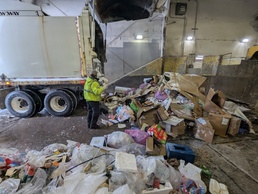
Sean Johnson, DPW Municipal Services chief, said recyclables are collected from the blue receptacles across post every Tuesday, Thursday and Sunday, and taken to the Solid Waste Transfer Station, located near Cerjan Gate. It typically takes a team of four approximately three to six hours to process a single load – roughly several tons of recyclable items – before it is transported to a local materials recovery facility.
“Our guys will empty a truck onto the ground, separate the recyclables and pull out any trash that’s commingled in with the recycling,” Johnson said. “Sometimes people will throw in bags of regular trash and other items that contaminates the load.”
Crawford said the more contaminated the load, the strain becomes greater on limited manpower resources to rectify those issues. In some cases, the loads are so contaminated that it ends up being disposed as municipal solid waste.
Crawford said a reduction in staffing last year as a result of the deferred resignation program and federal hiring freeze has impacted DPW’s Refuse and Recycle Program.
“It’s now even more imperative for people to do the right things in their areas of responsibility because we don’t have the bandwidth to correct every deficiency and that is leading to a downward trend in our diversion rate,” he said.
While Fort Drum incurs a cost for transporting recyclables off post, Crawford said the DPW Environmental Division has been encouraging Soldiers to make some of their money back from the bottles and cans they’ve purchased.
“If you empty your returnables in the blue dumpster, you’re not doing anything wrong,” he said. “You’re recycling. But if you take those bags to a redemption center, that money can go toward unit functions. Have a barbecue at the end of every month.”
Another issue seen during routine site inspections is that when materials are placed in the wrong bins it often results in overflowing dumpsters. Heather Wagner, Fort Drum Environmental Division education and outreach coordinator, said that improper waste disposal creates serious health and safety concerns.
“You can attract nuisance animals, like raccoons, in your area," she said. “Overflowing dumpsters and trash left on the ground can attract pests and create hazards like broken glass.”
“It's also good order and discipline,” Crawford added. “You don't want to come into work and look at a trash pile outside of your office.”
Crawford said it’s important to note that Mountain Community Homes provides its own municipal trash service for residents and that it is independent from what the Directorate of Public Works provides.
“The only thing we are authorized to accept at our transfer site that comes from on-post housing is electronic waste,” he said. “We are a registered e-waste collection point, so people can bring in their old TVs, computers, printers and things like that, and we will recycle them. We also collect household hazardous waste, but that is done at a completely separate facility and not the Solid Waste Transfer Site.”
How You Can Help
“In New York State, we are required to recycle under the Solid Waste Management Act,” Crawford said “So, this is not even about finding the time to recycle or it being the right thing to do. It’s a legally required mandate for us to try and recycle everything that is a commodity for recycling.”
[Editor’s Note: This is the first in a series on DPW’s Refuse and Recycle Program]