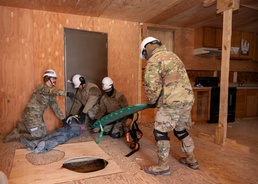
FORT LEONARD WOOD, Mo. — The Maneuver Support Center of Excellence Homeland Defense Civil Support Office develops capabilitiesand provides training to improve the U.S. Army's effectiveness for operations in the homeland. One way it accomplishes that mission is through the urban search and rescue courses taught at Fort Leonard Wood.
“The training students receive is designed to assist civil authorities with response to Chemical, Biological, Radiological and Nuclear incidents in the homeland to save lives, protect property and the environment, and reduce the effects of the incident on the general public,” said John Miller, Urban Search and Rescue Training Department chief.
Currently, there are three urban search and rescue courses offered at Fort Leonard Wood, which are Rescuer, Extractor Level I and Extractor Level II.
“All the courses provide specific training parameters outlined by the National Fire Protection Association,” Milled said.
The Rescuer Course is a 38-day certification on rope, confined space and collapse training, which includes machinery, common passenger, heavy vehicle and trench rescue.
During the 13-day Extractor Level I Course, students receive certification at the awareness and operations level for rope, confined space and structural collapse rescue.
The Extractor Level II Course is a 12-day certification at the technician level for rope, confined space and structural collapse.
“These courses are both mentally challenging and physically demanding. They are delivered at a very fast pace with numerous written exams and skills evaluations — one course exceeding over 50 skills exams,” Miller said. “Students must stay physically and mentally sharp for the entirety of the course to be successful.”
The courses are delivered to Soldiers assigned in direct support of the Chemical Response Enterprise mission that provides specialized, rapid-response capabilities to support civil authorities during domestic incidents.
According to Miller, the Urban Search and Rescue Training Department has the capacity to train more than 600 students each year and are made up of members of the Homeland Response Force, active duty and Reserve Soldiers assigned to support the Defense CBRN Response Force, as well as National Guard Soldiers who are assigned to the CBRN Enhanced Response Force Package in their states.
One of those students, Spc. Allison Wilson is a CBRN specialist with the U.S. Army National Guard.
She said she jumped at the chance to take the Extractor Level I Course because she is part of the CBRN Enhanced Response Force Package, commonly known as CERFP, in her home state of Alabama.
“I am so excited to be here. This is an amazing opportunity,” Wilson said.
“The course has been a lot to take in but being able to absorb all the information and apply it is what really makes this course remarkable. We had to embrace multi-tasking and working together as a team to accomplish our goals.”
She said she got hands-on experience with several new tools, mechanical concepts and even mastered the ropes class at the top of a 60-foot tower.
“I have never used a saw before,” Wilson said. “And I loved the ropes class, which is crazy because I thought I was terrified of heights. I went up there and built the rope system and went down the tower.”
Another first for her? Seeing snow.
“I saw the forecast before we left Alabama, but I really didn’t think it was going to snow,” she said.
It was warmer when Wilson went through one station unit training at Fort Leonard Wood a few years ago, but she said she feels fortunate it snowed during this course, which trains mostly outdoors at Training Area 235.
“It has been very beneficial for me to learn to operate in these conditions. It is important for us to be able to successfully respond in any weather or climate,” Wilson said. “When people need us, our comfort doesn’t matter. We are here for them.”
Other than the frigid temperatures and slick conditions, Wilson said the most challenging part of the course for her was the lift and move portion of training.
“It took a lot of brain power and working together to figure out how to get to a buried victim without interfering with or damaging the structure further,” she said.
The new skills she is leaving Fort Leonard Wood with make her feel like she is fulfilling a goal she has had since she was 12 years old, “to serve others and make a difference,” she added.
“I have always wanted to do something for my country. I feel like I am in the right place at the right time to be able to use my Army skills to help people,” Wilson said. “If there is a chemical attack, not only can I assess the weapon, but I can also help the victims while I am there. I feel like I am a more well-rounded Soldier now.”
To view the courses offered through MSCoE homeland defense, visit [Fort Leonard Wood’s Homeland Defense Civil Support Office website](https://home.army.mil/wood/units-tenants/hdcso).