Story by Kathleen "Kat" Pettaway-Clarke
Corpus Christi Army Depot, Texas--The enduring fleet of the Army's Blackhawk helicopter ensures a continuous workload for the Corpus Christi Army Depot in South Texas, particularly in the remanufacture of legacy platforms. In response to this sustained demand, CCAD has launched the first organic composite repair program for helicopter blades in the United States.
Corpus Christi Army Depot Commander COL Kevin Considine said, “Composite blades aren't going anywhere. CCAD is a very important part of the industrial mix, and the depot takes pride in our products.”
This initiative is a critical component of the depot's product verification audit. In Army Aviation, a Depot Product Verification Audit is a specialized quality assurance inspection conducted by a higher echelon, such as the Aviation and Missile Command or the Defense Logistics Agency. Its primary purpose is to verify that the parts being manufactured or overhauled at the depot meet the exact engineering and safety specifications before they are sent back to the fleet.
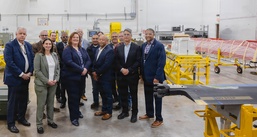
In conjunction with the launch of its organic composite repair program, CCAD hosted a visit from Jennifer Martone, the Program Director for Black Hawk Sustainment and International Helicopter at Sikorsky. Sikorsky is a key partner.
Deputy and Chief Operations Officer Roderick Benson said, “The Sikorsky name is trusted to execute some of the most demanding military missions. That trust is earned through decades of excellence, and it continues to set the standard for rotary wing aviation.”
This was Martone’s first visit to the depot and is responsible for overseeing strategies related to spares and repairs. Specialized capabilities at CCAD, such as non-destructive testing, make the depot an attractive partner for industry leaders like Sikorsky. Non-destructive testing allows inspectors to identify defects such as cracks, corrosion, or heat damage within a component without requiring disassembly.
"What stands out about our work with Corpus Christi Army Depot is our shared focus on the warfighter,” said Martone. “Our visit to CCAD reinforced how our combined expertise keeps Army Aviation mission-ready whenever it’s called.”
The collaboration between Sikorsky and CCAD is vital, as evidenced by the Direct Sales Partnership Agreement signed in 2018. Following this agreement, both entities began working on the implementation of the M-model blades program.
According to DSPA Program Manager Lyndon Smiling, “The process took several years and was delayed through a series of setbacks such as COVID, supply chain, and tooling issues, and now the depot has received three M-model blades.”
“We are grateful for the opportunity to support Sikorsky as a partner, and we take pride in contributing to a legacy that serves those who serve,” said Benson
The depot categorizes rotary blade repairs into three levels: full overhaul, Category 2, and Category 3. A full overhaul involves stripping the blade to its core, which includes removing all finishes, inspecting the internal structure, replacing leading-edge strips, and re-balancing the blade to industry specifications. Category 2 repairs address significant but non-structural damage, such as skin delamination, larger composite punctures, or eroded components that exceed field-level repair limits. The final category, Category 3, involves complex structural reinforcements or the use of specialized tooling to bond materials. Non-Destructive Testing is part of those processes.
A potential halt in the production line due to the phasing out of LEAP minutes could lead to a parts deficiency, ultimately increasing maintenance bottlenecks. This situation, however, presents an opportunity for CCAD to expand its role as a depot product verification auditor. By acting as a gatekeeper, the depot would ensure that all aircraft parts are airworthy.
The Continuous Transformation framework has three concurrently executed time horizons: Transforming in Contact (near-term efforts), Deliberate Transformation (mid-term efforts) and Concept-Driven Transformation (long-term efforts). This ongoing transformation allows us to adapt and evolve how we organize, equip, train and fight, and provides the Joint Force with lethal, adaptable and flexible forces.