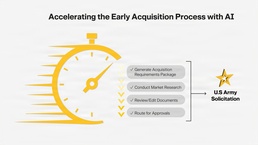
In today’s heavily contested global environment, the ability to quickly get Soldiers the capability they need is paramount. In recent years, the administrative nature of the early procurement process has generally slowed things down. New artificial intelligence (AI)-enabled tools the Army is piloting may be a gamechanger, however.
In January 2026, personnel at Army Contracting Command’s (ACC) Aberdeen Proving Ground, Detroit Arsenal and Rock Island contracting centers began testing AI prototypes under ACC’s Smart Contracting Initiative. One of those technologies is designed to simplify the development of Acquisition Requirement Packages — the collection of documents that demonstrate what the government is buying and how applicable laws and regulations are satisfied. Using the AI-enabled tool can reduce the time required to complete the packages from weeks to hours, or — in some cases — minutes.
According to Patrick Colleran, director of acquisition management at U.S. Army Program Executive Office Enterprise, ARP development is the “single biggest muscle movement” in the pre-contract award period, requiring acquisition teams to try to ensure consistency throughout hundreds of pages of evolving requirements documents that can contain a lot of duplicative and potentially conflicting information. ARP inconsistencies can potentially lead to confusing solicitations, delays in the industry Q&A process, possible protests and, ultimately, costly delays in getting capability to Soldiers.
The Army’s AI-enabled ARP prototypes — three of which were funded by the Army Small Business Innovation Research (SBIR) Program in September 2024 — are helping acquisition teams rapidly pull changes through acquisition packages. Once a final ARP is ready, contracting personnel can quality-control it for accuracy.
“We believe we’ve caught lightning in a bottle with these prototype projects,” said Colleran. “If the Army must fight tonight, we’re going to need a lot of stuff quickly. Prepositioned supplies and inventories will only go so far. A tool like this, which accelerates the path to contract award, is a critical event.”
PEO Enterprise, which came up with and pitched the AI-enabled ARP concept, successfully used one of the AI prototypes in fiscal year 2025 to produce two supply-type contract awards. Now the Army is piloting the AI tools for a wider array of contract actions, including service-based acquisitions and other classes of supply beyond IT.
Ultimately, Colleran hopes to integrate the tools with other Army procurement systems.
“Our goal is to integrate the tool so that it can fully populate a solicitation within Army Contract Writing System and send the ARP documents directly into the contract file of record,” he said. “Right now, the user has to download files and manually move them over.”
Moving forward, PEO Enterprise aims to speed up other parts of the acquisition process as well. In fiscal year 2026, the organization is anticipating SBIR awards for two AI source selection tools it pitched to the Army’s SBIR office, said Colleran.
“We’re not removing humans from the loop,” he said. “We’re leveraging technology to help our teams become more efficient without sacrificing quality.”