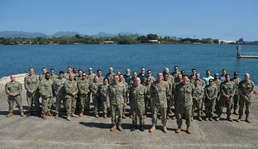
The Navy Expeditionary Logistics Support Group(NAVELSG) is strengthening the Navy’s ability to sustain operations in the Indo-Pacific through participation inKeen Edge, a U.S.–Japan bilateral exercise focused on large-scale operational planning and logistics readiness.
Keen Edge is a recurring annual exercise that allows U.S. and Japanese forces to rehearse how they would respond to regional crises. Rather than moving forces in the field, the exercise simulates real-world conditions to test decision-making, coordination, and sustainment, the systems that ensure military forces can operate effectively when deployed.
During this exercise, NAVELSG is participating as part of a logistics sustainment task force responsible for planning and coordinating rearm operations. Rearm operations ensure Navy forces can replenish weapons and remain operational effectively and efficiently in theater, an essential capability for deterrence and response in the Indo-Pacific.
NAVELSG’s 5th Navy Expeditionary Logistics Regiment (5th NELR) is providing command and control for these rearm operations, supporting Navy Munitions Command forces operating across the region. From Joint Base Pearl Harbor–Hickam, the unit is coordinating how expeditionary rearm teams would be employed during a real contingency.
The exercise allows NAVELSG to practice managing multiple rearm elements at once, including expeditionary reload companies, Navy munitions units, and rapid-response teams. These rehearsals help ensure the Navy can quickly and safely rearm forces forward, reducing response time and increasing operational endurance.
For NAVELSG, the primary value of Keen Edge is gaining realistic training repetitions, often referred to as “reps and sets” in a simulated Indo-Pacific environment. These repetitions allow leaders to validate plans, identify gaps, and improve coordination before those capabilities are required in an actual crisis. “Our team was dispersed in various roles and integrated with Navy Munitions Command Pacific East Asia Division to assist in munition requests and other queries from the units involved in the exercise.” Said Senior Chief Boatswain’s Mate Anita Sisk, 5thNELR Regimental Training Chief.
NAVELSG’s participation also highlights the importance of logistics command and control. While combat forces receive much of the public attention, effective sustainment is what allows those forces to remain forward, credible, and ready. Exercises like Keen Edge ensure logistics units can integrate seamlessly with operational commanders and allied partners.
“Keen Edge highlighted that sustained logistics in a contested theater depends on protecting and managing distribution, which remains the primary vulnerability as fuel, munitions, and repair parts will be actively targeted. Effective sustainment requires built-in redundancy and dispersion, supported by real-time visibility of inventory, lift capacity, and consumption rates to prevent operational pauses.” Said CAPT Brendan Kearney, Commodore, 5thNavy Expeditionary Logistics Regiment (5thNELR) “Clear command relationships and pre-established trust between operational and logistics commanders are essential to rapidly resolve competing priorities and maintain operational tempo under stress.”
As the Department of War continues to prioritize stability and deterrence in the Indo-Pacific, NAVELSG’s role in Keen Edge demonstrates a commitment to ensuring logistics forces are trained, coordinated, and ready. By exercising these capabilities in advance, the Navy reduces risk, improves readiness, and ensures taxpayer investments translate into real operational capability when it matters most.
For more information about NAVELSG, visit the official command webpage at necc.usff.navy.mil/NAVELSG.