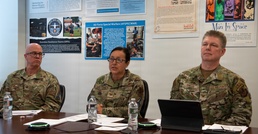
Air Force Medical Command leaders held a virtual town hall meeting Jan. 23, 2026, to discuss consolidated guidance for integrated operational support programs outlined in the Department of the Air Force Manual 10-211.
During the town hall, leaders engaged with more than 400 Air Force and Space Force participants to share updates to IOS, the relationship between DAF IOS programs and installation medical units, and the significance of the manual moving from a chapter in a 48-medical series document to a stand-alone 10-operational series DAFMAN.
IOS is the umbrella term for integrating critical health-related support services within units, directly serving Airmen and Guardians. These line-funded programs, which include at least one medical authorization, enhance readiness and performance by providing a spectrum of care from preventive services to primary clinical care. IOS is implemented in demanding environments, including military training, units at a higher-level of risk due to their mission or operations tempo, and functional communities with unique operational requirements.
Published in August 2025, the DAFMAN established an enterprise-wide standard for how IOS programs are approved, resourced, governed, and evaluated.
Stephen Mounts, Deputy Surgeon General and Senior Executive Service member, set the scene at the town hall, emphasizing the impact IOS programs have on readiness.
“These programsincrease every Airman and Guardian’s operational effectiveness and overall readiness by protecting and enhancing the health of those service members,” he said. “They are there toexecute mission‑specific duties, prepare folks for deployment and mitigate the overall impact of unique operational stressors.”
Chief Master Sgt. Erik Robbins, Senior Enlisted Leader, Medical Policy and Resources Directorate at the Air Force Surgeon General’s Office, discussed the operational support required for IOS programs, and detailed the new guidance monitoring their standards and evaluations.
“We’re not only helping you with the health aspect of it, but we’re also making you faster, better, and stronger,” he said. “We want to make sure we’re partnering together, and you have all the tools to be successful.”
Standardizing a proven model
IOS programs deliver interdisciplinary support across physical, mental, spiritual, nutritional, and medical domains, often integrated within squadrons, training pipelines, and high-risk mission units.
Over the past decade, IOS teams have expanded from three pilot programs to 28 programs across the force including the recent addition of Guardian Resilience Teams, driven by operational demand for human performance optimization, according to Col. Amalia DiVittorio, IOS Chief for the Air Force Surgeon General.
“We have been doing [this] since the beginning of warfare. We've had medics aligned with operational units and for the Air Force to adapt [with new guidance], this is no exception,” she said.
DiVittorio shared operational data during the town hall, highlighting measurable benefits of IOS services to human performance optimization. These included a 20% reduction in musculoskeletal injury profiles, a 5% decrease in MSK medical visits, and improvements in cognitive performance among aircrew through a human weapons system optimization program. These outcomes reinforced the need to formalize IOS under a single, department-wide framework codified in DAFMAN 10-211.
IOS resourcing and authority
Under this new guidance, IOS programs remainowned and resourced by line commanders, while theAir Force Surgeon General retains medical oversight authority. This structure preserves operational agility while ensuring clinical quality, patient safety, and compliance with Department of War medical standards.
Installation medical group commanders serve as the final authority on medical services that may be delivered outside traditional medical treatment facilities. They also are authorized to pause IOS clinical operations if safety or compliance standards are not met.
Elevating safety and quality of IOS programs
DAFMAN 10-211 also aligns IOS programs with enterpriseClinical Quality Managementrequirements, designating IOS care locations asoperational clinical services environments.
Col. James Shields, Chief, Specialty Operations Branch, AFMEDCOM, described the guidance as a centralized resource for IOS programs.
“It provides a common operating picture for existing policy and to execute these IOS programs in a safe, standardized manner while ensuring surgeon general oversight of IOS and operational clinical services,” he said.
The DAFMAN defines the credentialing, privileging, patient safety, and reporting standards IOS providers must meet, which are aligned with Military Health System standards.
Enabling Air Force, Space Force readiness
By clarifying authorities, funding responsibilities, and quality expectations, leaders said that the new IOS guidance serves to monitor and clarify embedded health and performance capabilities within this standardized framework, supporting readiness today while building a sustainable model for the future.