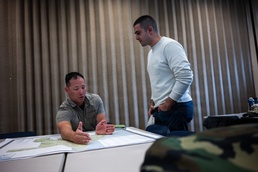
WHIDBEY ISLAND STATION, Wa. - In preparation for an upcoming deployment, Soldiers assigned to 3rd Squadron, 5th Security Force Assistance Brigade (SFAB) and attachments conduct a training mission that focuses on improving effective advising skills. The Mission Readiness Exercise (MRX) is an advisor pre-deployment certification executed before advisor teams deploy globally to operate independently and assist partner nations with optimizing capacity and building multinational interoperability. The exercise utilizes a mock partner force that places advisors in scenarios where they are presented with personality and cultural differences, realistic to situations they may find themselves in while deployed. U.S. Army Capt. Kyle Haddock, fires advisor team leader assigned to 5th SFAB, explains that his Soldiers advise on effective planning and tactics, so that the partner forces can integrate the newly learned skills into their own units. Haddock emphasizes “greater proficiency” for partner forces in advised areas. U.S. Army Command Sgt. Maj. Geriah Mcavin, command sergeant major of 3rd Squadron, 5th SFAB, explains that the exercise allows advisors of the squadron to replace theory with practice. “It allows them to rehearse partner force advising through role players,” says Mcavin when speaking on the importance of the exercise. “We could tell [the advisors] all day how to advise. But when you actually have human interaction, it replaces that with experience.” For experienced advisors, the MRX is a review of what was learned in previous deployments. However, new advisors find extreme value in its execution being away from Joint Base Lewis-McChord. “You have to get out of the gate”, says Haddock when describing the significance of completing the exercise away from Joint Base Lewis-McChord. “There, we are in the office learning doctrine. We're discussing tactics with each other. But until you actually get out and talk with the partner force, you're never going to be able to exercise that skill.” Training away from home brings the training value close to that of deployment. All aspects of travel, navigation, and mission execution were team-level tasks. This provided Soldiers with the opportunity to build team cohesion before the real deployment. “It makes this feel like a real engagement,” says Sgt. 1st Class Tyrone Rowe, a logistics advisor assigned to 5th SFAB. “It's preparing us a lot. It's helping us work better as a team with our partners.” The MRX helps team leaders focus on which aspect of their advising skills needs improvement. Mcavin describes the most essential skill as relationship building. He explains that trust in relationships leads to greater opportunities for advisors and partner forces to influence change, so that the skills and information are adapted together, rather than just advisors “telling them how to do things”. "You’ve got to be able to build a relationship with a partner. You know, break down those walls that we naturally have with people we don't know”, adds Haddock. The MRX builds confidence in the advisors’ ability to take initiative in future deployments and the ability to positively transform alongside partner forces for maximum efficiency and interoperability on the battlefield. When asked what he is looking forward to during the upcoming deployment, Haddock says, “Getting to work with partner forces again.”