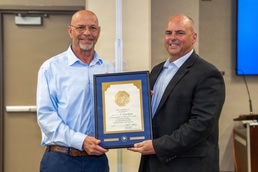
Jim Loundagin was testing missile hardware with whatever tools were available.
It was 1989. Loundagin had just joined the Fiber Optic Guided Skipper program at Naval Air Warfare Center Weapons Division. The team needed to know whether a fiber optic bobbin could survive the force of a missile launch. They did not have a missile ready. They improvised.
“We were shooting compound bows out the back door,” Loundagin said. “We were firing shotgun slugs too, just trying to simulate the acceleration of the bobbins.”
That kind of work defined a generation of NAWCWD engineers. Hands-on. Inventive. Accountable for every result.
Loundagin has spent 35 years at NAWCWD building, testing, and delivering weapons to the fleet.
His career began with that scrappy fiber optic missile effort. He currently serves as the kill chain subject matter expert for the Long-Range Anti-Ship Missile. This missile is the Navy’s primary air-launched anti-ship weapon.
Along the way, he learned that the hardest-won knowledge comes from failure, and that passing it forward may be the most important work he does.
A self-contained operation at Cliff Gate
The Fiber Optic Guided Skipper program took Army fiber optic bobbin technology and applied it to a Navy air-launched missile. This version uses a physical data link rather than radio signals. The concept called for a missile to deploy kilometers of fiber optic cable while flying. It also needed to maintain command and control at high speeds.
“Winding that much fiber out of a bobbin and releasing it at 500 miles an hour without it breaking was really challenging,” Loundagin said.
The program ran from a group of buildings up on a hill inside the China Lake Propulsion Laboratory. It had around 20 team members, mostly from the original Skipper missile project. The program relied on low-cost components and pushed performance beyond what its price suggested.
“We were kind of like the rebel program that nobody wanted,” Loundagin said. “We were trying to do something cheap and make it go far.”
Within that small team, Loundagin carried responsibility that extended beyond his title. He integrated mission electronics, software, and data links and translated commands from the aircraft control pod to the missile.
“That was all me,” he said.
The gremlin in the lab
Before the program reached its first guided drop, Loundagin noticed a problem during laboratory testing. At times, the data link stopped sending fin commands to the missile. The issue appeared without a clear pattern.
“I always just thought it was like a gremlin thing in the lab,” Loundagin said. “I’d power cycle it and then everything would work again.”
The gremlin followed him to the range.
“We went to drop one of the first guided rounds,” Loundagin said. “The missile tipped straight over, the rocket motor fired, and it went straight into the dirt.”
The failure forced a closer look.
Loundagin returned to the code. Within 10 minutes, he saw the problem.
“I realized I had what was called a fatal embrace,” Loundagin said. “Two computers were trying to talk to each other, and both were waiting.”
The system locked. The missile received no commands.
After the incident, senior systems engineer Gary Ozunas, a veteran of the original Skipper program, became Loundagin’s mentor. Ozunas reinforced discipline, readiness, and accountability before weapons ever reached the range.
“If you see something funny in the lab, it doesn’t matter if it’s one time or two times,” Loundagin said. “You have to figure out what was going on.”
That lesson followed him through eight programs, more than 75 test events, and 35 years. It became the first thing he taught engineers who worked for him.
Fifteen shots from the bunker
After the Fiber Optic Guided Skipper program, Loundagin took on new roles that expanded his skills and took him out of the lab.
His work took him into flight testing, where he built systems and watched them perform in the air during data collection missions at China Lake.
Then came the Low-Cost Guided Imaging Rocket program, known as LOGIR.
LOGIR aimed to turn unguided rockets into precision weapons by adding a guidance kit to the front end.
“You’d see those old Vietnam movies where helicopters fire rockets and they scatter everywhere,” Loundagin said. “This was taking those same rockets and putting guidance on the front so they actually went where you wanted.”
Loundagin served as fire control lead, responsible for every live launch.
“All 15 LOGIR shots,” Loundagin said. “I was the one pushing the button from the bunker.”
He spent a decade on LOGIR and its successor, the Medusa program. The work stayed hands-on, but the stakes increased.
Across decades of development work, the pattern stayed the same.
Design it. Build it. Test it. Own the result.
A desperate need by the fleet
At one point, Loundagin made a deliberate choice to leave development work behind.
“I’d been doing the lab rat thing for 25 years,” Loundagin said. “I wanted to go support programs that were actually in the fleet.”
That shift led him to the Long-Range Anti-Ship Missile, a Defense Advanced Research Projects Agency effort to close a gap in long-range, air-launched anti-ship capability. Loundagin joined the program before its first flight test and remained through its earliest milestones.
“There was a desperate need by the fleet for this weapon,” Loundagin said.
He stayed with the program through its first delivery.
“We delivered the first 10 rounds to the U.S. Navy for carrier use,” Loundagin said. “On time.”
The weapon closed a capability gap the Navy had carried for years. The work demanded judgment shaped by decades of testing, with little margin for error.
He now serves as the kill chain subject matter expert in the FX Technical Project Office, supporting current and future capabilities.
The one thing that’s hard to get
Loundagin grew up in Ridgecrest, California, where his father worked as an air-breathing propulsion engineer. He never left. Thirty-five years and eight weapon systems later, he still rides mountain bike trails from his front door and keeps his life rooted in the desert and the mission, alongside his wife, Kristina, who also works at NAWCWD.
He watches a new generation of engineers arrive at NAWCWD. They come in capable and motivated. Their opportunities look different.
“I feel bad for some of these young engineers,” Loundagin said. “They didn’t get to do the fun stuff I did.”
Fewer programs allow engineers to design hardware, write code and execute live launches. The hands-on path that shaped Loundagin’s judgment is harder to replicate.
That experience now shapes the engineers around him.
Alex McCourt, an engineer who has worked with Loundagin for the past two years, said Loundagin’s mentorship extends beyond technical guidance.
“Jim’s experience and approaches to both work and life have been incredibly beneficial to my professional development,” McCourt said.
“The one thing that’s hard to get is all that experience,” Loundagin said. He does not take that experience for granted.
“There’s not one job I look back on and regret,” he said. “I’ve been very lucky.” Luck did not deliver 10 LRASM’s to the carrier fleet on time.
When asked what he is most proud of, Loundagin paused.
“Supporting the warfighters,” he said. “Not just blowing stuff up in the desert.”