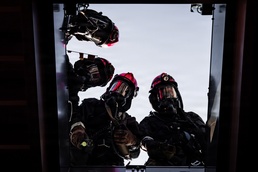
FORT BRAGG, N.C. - U.S. Army Soldiers from units across the force converged at Fort Bragg from February 10-12 to validate their readiness as part of Task Force 2 under the Defense Chemical, Biological, Radiological, Nuclear and Explosives (CBRNE) Response Force (DCRF). The training ensures the Soldiers remain prepared to deploy on no-notice orders in response to a potential weapon of mass destruction attack within the United States. The culminating exercise brought together chemical, medical, engineer and military police units to simulate a large-scale domestic response following a catastrophic chemical or biological incident. The training evaluated the task force’s ability to secure a contaminated site, conduct technical rescues and decontaminate mass casualties under realistic conditions. “The purpose of this exercise is to ensure we are ready for no-notice deployments in case any city in the United States is attacked with a weapon of mass destruction,” said Command Sgt. Maj. Alvaro Madrigal, the senior enlisted leader for Task Force 2. “We are essentially 911 in case something big happens.” Task Force 2 operates under the U.S. Northern Command as part of the DCRF mission, which provides rapid-response capabilities to support civil authorities during domestic CBRNE incidents. The task force is composed of three primary operational components: hazardous materials reconnaissance, urban search and rescue and mass decontamination. The hazmat element, led by the 21st Chemical Company, 48th Chemical Brigade, conducts reconnaissance of the affected site to determine contamination levels and establish safe operating zones. The unit continuously monitors conditions to ensure the safety of responding forces and civilians. Following a site assessment, the urban search and rescue component, composed primarily of Soldiers from the 50th Multi-Role Bridge Company, 5th Engineer Battalion, 1st Infantry Division, conducts technical rescues in structurally compromised environments. In the event of a detonation, collapsed building, or contaminated structures that cause trapped civilians to require a specialized extraction operation. “If there is a detonation, there will be structural damage and people sheltering in place who can no longer leave,” said 2nd Lt. Galina Gordon, a team leader for the 50th Multi-Role Bridge Company, 5th Engineer Battalion, 1st Infantry Division. “We conduct those technical rescues for however long it takes.” Once victims are extracted, the mass decontamination team processes affected personnel to remove hazardous contaminants and prevent further exposure. The Soldiers are trained to rapidly decontaminate large numbers of individuals, enabling medical personnel to provide follow-on treatment and move civilians to safety. Supporting the operation is the 602nd Medical Company, 44th Medical Brigade, responsible for treating both service members and civilian casualties. During the exercise, local community role players replicated injuries consistent with a weapon of mass destruction scenario, adding realism to the training environment. The 41st Military Police Company, 89th Military Police Brigade, serves as a general purpose force, providing additional manpower where needed, from assisting with casualty movement and litter carries to augmenting decontamination and rescue operations. Observer-controllers evaluated the training event, assessing performance across all warfighting functions. Following the exercise, leaders conducted an after-action review to identify strengths and areas for improvement ahead of a larger-scale validation exercise. Task Force 2 will next participate in Guardian Response at Camp Atterbury, Indiana; an annual large-scale exercise that brings together multiple regional response forces in a highly immersive disaster scenario. The training environment features collapsed structures, overturned vehicles and complex rescue lanes designed to replicate real-world devastation. “Guardian Response is much more immersive,” Madrigal said. “You’ll see buildings torn down, vehicles upside down and victims requiring rescue from difficult environments. It’s a larger-scale event where multiple task forces come together to validate readiness.” Each DCRF-aligned task force is assigned responsibility for a specific region of the country, ensuring rapid response coverage nationwide. The integration of chemical, medical, engineer and military police capabilities enables the force to operate as a synchronized, life-saving element during domestic emergencies. “These reps are important,” said 2nd Lt. Galina Gordon. “When it’s game time, there is no room for failure. We have to know how to work together and understand what each unit brings to the fight.” Through realistic training and interagency coordination, Task Force 2 continues to strengthen its ability to protect and support the American people in the event of a catastrophic CBRNE incident.