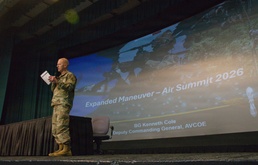
FORT RUCKER, Ala. - The Aviation Branch hosted the Expanded Maneuver-Air Summit 2026 at Fort Rucker Feb. 10-11.
The sequel event to last year’s Unmanned Aerial System and Launch Effectssummit, and the 8th such summit of this type, the Expanded Maneuver-Air Summit featured panels and presentations on the progress made, and future of, Unmanned Aerial Systems and other drones and robotics in the US Army. Last year, much of the presentations and discussion was on the Department of War expanding authorizations of UAS acquisition, off the shelf acquisition, the need for specialists in drone warfare, and the unmanned systems used by the Army.
This year those units that took those systems, programs, and people, and put them into use, and presented their findings, looking at what worked, and what the Army would need to do moving forward to fully integrate unmanned air systems into everything from use in training events and possible future conflicts, to the logistics and training pipelines required to sustain these capabilities.
The event opened with some words from Maj. Gen. Clair Gill, commanding general of the Aviation Center of Excellence and Fort Rucker. “This is really about adapting and accelerating,” Gill said. “It’s about getting the capabilities into the hands of the warfighters sooner.”
Then began the panel discussions that made up the majority of the summit. Units and organizations including deployable units, special operations, groups with new drone training facilities, and Soldiers with access to the latest information on live drone operations in combat, all presented what they were doing, learning, and the challenges they’d encountered. Over the last year all these units and more have been acquiring unmanned systems and integrating them into their operations, trying out new ideas, and learning what works and what does not.
Every panel and speaker unanimously agreed that the new specialty of Soldier, and the unmanned systems they’re trained to employ, bring valuable capabilities, and will be a vital asset both for the US Army in the next conflict.
There were also several challenges the units discovered, presenting hurdles and proposing solutions that could pave the way for the US Army’s drone dominance in future conflicts.
Airspace management was a near universal concern brought up by most panels that made use of unmanned aircraft.
In every exercise and event the various units executed with new drones and unmanned systems, they had to work out how to safely manage the airspace and allow the use of all the existing manned and unmanned systems and include the new sUAS and drone aircraft that would be both part of the unit’s future as well as drones in use by the opposition.
“One of the things I think we’re starting to tackle is how do we deconflict with small UAS, the problem being there is a saturation of enemy UAS, or unknown UAS in the battlespace, and we just don’t know where they are at any given time,” said Lt. Col. Joseph Imbraico, an aviation and airspace observer coach/trainer at the Joint Multinational Readiness Center in Hohenfels, Germany. “So even if I know that we can deconflict, or synchronize, coordinate to stay away from blue (friendly) UAS, how do we stay from red (enemy) UAS?”
Introducing drones into the airspace has been an ongoing effort by the Army for some years now, but the dramatic increase in the total number of aircraft as drones become easier to operate and more available is creating a more congested airspace and putting more pressure on the operators to coordinate with their manned counterparts.
“We’ve got to train UAS and rotary wing simultaneously, and teach them airspace management,” Imbraico said. Different panel groups all made similar observations: The systems and methods the Army and FAA uses to manage airspace were never really intended to handle the scope and scale of drone heavy operations. “We need a simple permissive airspace structure that we can train with.” said CW3 Joseph Schwermer, a UAS officer with the 25th Infantry Division.
The panelists from both the 82nd and 101st Airborne Division presented their immediate solutions involving ways to “block off” airspace, establish routes, and do other things to deconflict the air, keeping manned and unmanned systems separate. However, the issue of things like opposition drone usage and airspace is expected to be an ongoing challenge. Some panelists also proposed a need for a new dedicated airspace management system that can be used both for domestic training missions, and in theatre when deployed.
Killchains, the method of getting target information from spotting units to units with the ability to strike them, was also identified as a place where improvement would be required to meet the needs of drone dominance. Using drones and other UAS to observe locations and find targets is not new, but dropping unmanned systems down to lower echelons is revealing the increase in units with the ability to spot targets is rapidly overwhelming and slowing traditional methods of identifying and prioritizing targets, assigning appropriate strike capabilities, and passing that information off to the units that will ultimately be firing the artillery and dropping the bombs. While the issue was agreed upon by all the presenting panelists, the proposed solutions were more varied, with panelists proposing things like implementing AI systems, changes to the kill chain structure, and making drone operator training and mission types more like that of a Joint Terminal Attack Controller.
The third shared point for improvement was in logistics and sustainment. This was a near universal challenge for nearly every panelist, as it all comes down to what the Soldier is even able to do and continue to do on the battlefield.
The right to repair, the ability and authorization for a Soldier to repair their own equipment came up regularly. Many drone systems have limitations on what a Soldier can do. In some cases, it’s technical, with things like the parts being highly specialized, proprietary, or otherwise only available or serviced by a single source.
“Right now, it’s all through vendors. We rely on these third-party vendors like PDW, Anduril, Skydio, etc. to provide these systems… but what we’re seeing is we break a drone… I coordinate with the vendor… I ship out the drone to get it replaced, and they send it back and say, ‘that’s not covered by warranty,” said Schwermer.
Some issues were more about business decisions made by contractors, with systems like the MQ-1c Grey Eagle requiring a full team of contractors to fully utilize, and contract driven limitations that prevent even some of the most basic of maintenance. Inconsistent service was also a noted issue, with contracts stipulating tight limits on repairs the company would even allow, and what facilities were authorized to make them.
“The Army needs to stop buying services, and start buying systems” said CW4 Javi Rivas, a UAS team member at Army Special Operations Aviation Command.
Probably the most obvious of shortfalls is the fact that most drone manufacturers make or use proprietary components for universal functions. Remote controllers, monitors and first-person-viewing goggles, and batteries are nearly all functionally identical across similar unmanned aircraft. However, there are no established standards, so each manufacturer makes their own version of such components, which are not compatible or interchangeable with other drones, even ones that are essentially identical in form and function.
Getting more detailed, the panelists spoke to the issues of arming drones by applying aftermarket and semi-improvised solutions like securing explosives to off-the-shelf drones. While fighting in Ukraine has proven this method to be effective, doing so requires specialized parts and training that the Army doesn’t have or give to most Soldiers. Even training with the systems is extremely difficult as there’s a lot of special safety considerations, required technical personnel, and authorizations to conduct the training.
“We all see Ukraine doing this, and then we do it, and it’s like ‘Wow, that was a lot, I don’t know if we want to do that again.’ and my recommendation is… don’t. Do it, prove that you can do it, exercise with constraints with range control… so before you think you need to put this into every single live fire, take a look, that's it’s a good use of resources.” said CW2 Matt LeMay, a UAS officer with the 25th Infantry Division.
The summit also included a presentation by the Security and Assistance Group - Ukraine discussing drone utilization by that nation in its war with Russia and how it may reflect future conflict the US may have to fight. The presentation reviewed how Ukraine was manufacturing most of its drone and other systems domestically to address logistics challenges, and how the Ukrainian military is making extensive use of unmanned systems both in the air and on the ground to allow smaller units to perform missions and functions that would traditionally require far more Soldiers. The prevalence of electronic warfare in Ukraine also means that not only have the drone systems had to adapt with things like un-jammable fiber optic connections, but also even normal GPS navigation systems won’t work.
“We’ll need to have Soldiers that can read maps,” said Lt. Col Mary-Kate Shuster with the Aviation Catalyst Team. One of the closing presentations was on UAS modernization. A highlight of the future of drones in the Army is the Army’s online marketplace that’s expected to be deployed in the coming year. This will be a website that will allow units to go in and purchase from a list of authorized systems with the same ease a private citizen might have purchased anything from an online shop. One of the features of the marketplace will be individual product reviews, allowing Soldiers that have used the equipment to give feedback on it, and rate the system.
“If there’s an issue, that can be brought up through the marketplace,” said Lt. Col. Jeff Bess from Program Manager Unmanned Aircraft Systems.
Just like with any other online markets, this information will be displayed alongside the product listing, allowing other Soldiers to see what systems other Soldiers have found to perform, and which systems were found lacking. Likewise, this will allow the vendors to learn about their products’ real-world shortfalls and address them with future developments.
At the end of the summit Brig. Gen. Ken Cole, deputy commanding general of the Aviation Center of Excellence, took a moment to talk about the importance of the new Military Occupational Specialty 15X, the Tactical Unmanned Aircraft System Specialist.
“The Army has challenged itself to produce a new MOS… we’re combining two MOSes to create something completely new, and we’re going to do the same with our 150U Warrant Officers,” Cole said.
The 15X came up throughout the summit, with panelists talking about the large skill expectations of the new Soldiers. At different times throughout the summit different panelists pointed to not just skill in operations of the unmanned aircraft, but also an expectation to repair, maintain, arm with explosives, coordinate airspace, advise leadership on UAS and other drone systems usage and more.
As a new MOS, the exact function of these Soldiers is still being decided, and Cole encouraged the units receiving this new specialty of Soldier to contribute to that decision by making use of the Soldiers, learning what unmanned systems can do for them at the level they’re needed.
“For the formations that are out there, make use of them as you see fit. It’s not been decided where they are going to go, but they are not all going to be in a combat aviation brigade.” Cole said. “They are going to be in your formations down to the battalion level.
In closing Cole thanked everyone for their attendance, the information presented, and their dedication to the future of the Aviation branch.