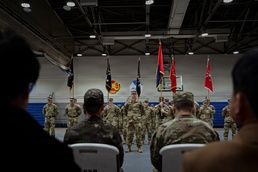
Camp Casey, South Korea— On Feb. 12, 2026, Command teams and representative Soldiers stood in formation to formally transfer authority from the outgoing 1st Stryker Brigade Combat Team, 4th Infantry Division (Raider Brigade), to the incoming 2nd Stryker Brigade Combat Team, 2nd Infantry Division (Lancer Brigade). Marking the conclusion of the Raider Brigade’s presence on the peninsula.
The Transfer of Authority ceremony formally serves as a warm handoff between Raider Brigade and the incoming Lancer Brigade, reinforcing the enduring commitment to the defense of the Republic of Korea and the strength of the U.S.-ROK alliance.
“The successful transition from KRF 16 to KRF 17 demonstrates the enduring nature of our alliance. The Raider Brigade came to Korea ready to serve and will return again, ready”, said Col. J. Clint Tisserand, Commander of the 1st Stryker Brigade Combat Team, 4th Infantry Division.
Korea Rotational Force (KRF) units are U.S. Army rotational units that have deployed to the Republic of Korea on a recurring basis for more than a decade to maintain combat-readiness in the Indo-Pacific.
The U.S. Army has maintained a continuous military presence in South Korea since 1945 (post-World War II occupation) with large-scale deployments during the Korean War.
These nine-month KRF rotations provide the U.S. Army with trained, modern formations capable of immediate response while strengthening interoperability with Republic of Korea Army (ROKA) units through consistent training.
During the rotation, Raiders trained across the peninsula with ROKA forces, where both Armies participated in multi-echelon combined live-fire exercises (CALFEX), force on force exercises at a Korean Combat Training Center (KCTC), international training events that included New Zealand forces, situational training exercises, Expert Soldier and Expert Infantry Badge events, command post exercises, and large-scale training events designed to replicate the stress and complexity of modern conflict.
Extensive training during the rotation emphasized combined planning, command and control (C2), and learning to operate in Korea’s stringent terrain and environment.
Maj. Ed Hudelson, the Brigade Operations Officer in Charge (S3 OIC), had this to say, “This rotation [KRF-16] pushed the Raider Brigade to operate at a high tempo across multiple domains and echelons to build combat readiness. From Expert Soldier and Expert Infantry Badge opportunities to increasingly complex live fire exercises, Raiders trained alongside their ROKA counterparts to strengthen the alliance”, Hudelson explained. “This training culminated in the certification of every company through a combined arms live-fire exercise, integrating Next Generation Command and Control systems with effects from artillery, mortars, unmanned aerial systems, rotary wing assets, and ROKA tanks.”
The brigade’s forward deployment also provided Soldiers with valuable experience operating in a strategic environment where deterrence, readiness, and alliance assurance are inseparable.
Cpt. Andy Arreguin, Able Company Commander, 4th Battalion 9th Regiment (Manchu) shared, "Through rigorous combined training, the Korean Rotational Force builds more than just tactical proficiency—it forges genuine partnerships. We emerge as a more effective and integrated force, prepared for the challenges of tomorrow. The experience provides a unique opportunity for our personnel to build powerful relationships and, for some, to honor their own family's legacy of service on the peninsula, reinforcing the very foundations of our enduring alliance.
Noncommissioned officers from across the formation spoke to how this rotation was unique to show junior Soldiers the importance of discipline, accountability, and professionalism. Not only while training but also while engaging with the local community.
1st Sgt. Julian Pacheco, senior noncommissioned officer of Able Company, 4th Battalion 9th Regiment stated, "Training alongside our ROKA brothers-in-arms was an honor. Together, we forged our lethality in the crucible of Korea's unforgiving seasons and punishing terrain. From mountain peaks to sprawling urban centers, we integrated our forces into a single, seamless combat team. The Manchu Battalion came here to achieve unflinching readiness and absolute interoperability. Mission accomplished."
In addition to tactical proficiency, many leaders agreed that KRF-16 strengthened their operations and systems, to include sustainment, staff processes, and C2 operations. Constant training for an extended period allowed leaders to identify pitfalls and refine SOPs under realistic simulated conditions.
The rotation also reinforced the historical foundation of the U.S.-ROK alliance, forged during the Korean War and sustained through decades of combined service. Today’s rotational units continue that legacy by training shoulder to shoulder with ROKA forces in defense of shared security interests.
Col. Tisserand offered a reflection of the rotation’s challenges and sacrifice, “This operational deployment brought meaning to the message— hard people do hard things. Grit was demonstrated by our Soldiers who relentlessly trained in the sweltering heat and freezing cold, and by their families who kept home fires burning while their Soldier was away. I am grateful for every Raider’s selfless service.”
As the Raider Brigade concluded its mission, responsibility transitioned seamlessly to Lancer brigade, which will continue combined training and partnership activities across the peninsula.
Leaders said the lessons learned and partnerships built during the rotation will inform future training and operations across the Army.
For the Raiders, the Transfer of Authority ceremony marked the close of a demanding and consequential rotation where readiness and reinforced alliances were strengthened. After a successful nine months spent on the peninsula, one thing is assured— we go together! Katchi Kapshida!