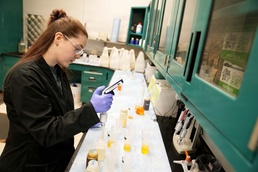
Inside a busy laboratory at Robins Air Force Base, Georgia, a team of chemists and technicians work tirelessly, ensuring the readiness of aircraft and the safety of personnel.
From verifying the structural integrity of aircraft components to safeguarding the base's drinking water, the Warner Robins Air Logistics Complex, WR-ALC, 802nd Maintenance Support Squadron’s Chemical Analysis Laboratory plays a critical role in ensuring Air Force readiness, both locally and globally.
Max Hetzer, 802nd MXSS Chemical Analysis Laboratory chief, said the lab utilizes cutting-edge techniques and equipment, ultimately enabling mission partners to deliver weapon systems sustainment.
“We provide expert chemical analysis,” said Hetzer. “This helps our partners deliver reliable weapon systems on time and within budget.”
The lab is split into two main sections.
The Industrial Process Support, ISP, Lab focuses on production quality. It tests materials used in aircraft maintenance, such as plating tank concentrations, purge fluids, engine oils, and epoxy. Fast turnaround times are key, with results delivered in just over a day on average to allow customers to make quick decisions and ensure smooth workflow.
The other section, the Industrial Hygiene and Shelf-life, IHSL, Lab, focuses on safety, health and environmental compliance. It analyzes hazardous waste, drinking water, and checks for harmful substances in work areas. This team supports various groups across the base, supporting personnel health and environmental integrity.
The impact of these labs on readiness is significant. The IPS Lab ensures that the processes utilized by 402nd Commodities Maintenance Group to produce aircraft parts meet strict standards, reducing rework and saving time. The IHSL Lab’s quick response to water testing prevents base-wide shutdowns, maintaining operational readiness.
According to Hetzer, by keeping the work in-house versus outsourcing, the labs also generate considerable cost savings. Shelf-life testing saves hundreds of thousands of dollars annually by extending the use of materials, reducing hazardous waste disposal costs.
The lab's reach extends beyond Robins. It supports organizations across the Air Force and Department of War, to include other bases' fire departments and even international partners requiring shelf-life testing.
Hetzer said that a critical area of focus is metal finishing and that without it, aircraft production could not be supported. Metal Finishing protects aircraft parts from corrosion and ensures paint adhesion. The lab meticulously analyzes the chemicals used, guaranteeing the quality of the finished product.
The lab constantly expands its workload. Recent additions include hazardous waste testing, expanded shelf-life analysis and potential support for polychlorinated biphenyl, or PCB, testing.
The lab boasts numerous certifications, including international standard organization, or ISO, 17025 accreditation, demonstrating its commitment to high quality standards. These certifications allow the lab to provide trusted results and expand its support to a wider range of customers.
Hetzer has witnessed remarkable improvements in quality, speed, and standardization since joining the lab in 2009.
“It makes me proud to provide same-day results, knowing we help return aircraft to the warfighter quickly,” said Hetzer.
According to Hetzer, the Chemical Analysis Laboratory’s diverse team brings a wealth of experience to complex challenges.
“Their work, from analyzing aircraft oil to ensuring safe work environments, is essential to Robins' operations,” he said.