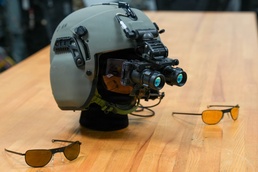
Airmen at Robins Air Force Base, Georgia, are helping to solve a growing problem among American pilots and aircrews across the world.
The Federal Aviation Administration says laser strikes on aircraft have increased by almost 48% since 2020 with more than 10,000 incidents alone reported in 2025.
Pointing a laser at an aircraft became a federal crime in 2012 and can result in a penalty of up to five years in prison and a $250,000 fine. Violators can also face FAA fines in addition to local and state criminal penalties.
“These strikes can cause serious and, in some cases, permanent eye damage, with health concerns ranging from temporary flash blindness to severe retinal injuries,” said Master Sgt. Bridgette Brzezinski, 78th Operational Medical Readiness Squadron Bioenvironmental Engineering flight chief. “Laser exposures can severely disrupt critical phases of flight, such as takeoff and landing, and can have significant psychological effects on aircrew even at distances where ocular damage is unlikely.”
To combat this threat, the Air Force Life Cycle Management Center Human Systems Division, or AFLCMC/ROU, is pioneering the next generation of protective technology.
The AFLCMC/ROU, based at Wright-Patterson AFB, Ohio, is working with their Operations and Support team at Robins on the Aircrew Laser Eye Protection – Technology Insertion program, an evolutionary acquisition program that replaces and upgrades laser protection eyewear every five to seven years.
Kevin Frost, AFLCMC/ROU Operation and Support mechanical engineer, and Eric Miltner, AFLCMC/ROU Operations and Support equipment specialist, are providing vital sustainment considerations to help develop improved eyewear to reduce the dangerous impacts of laser attacks on aircrews.
They are now working to field a new kit known as the Block 3 family of products. It is made up of six modular devices that are each worn under specific conditions during takeoffs and landings. The kit includes separate day, night and ballistics spectacles, and visors that provide peripheral protection while wearing night vision goggles.
Frost and Miltner say the latest changes include a new dye that can filter a wider range of light wavelengths and a new version of the night spectacles that allows more natural light through the lens, increasing visibility for aircrews.
“The main difference is that the Block 3s filter more wavelengths of light and provide more protection than the Block 2s,” said Miltner.
The duo also collaborates with technicians and Airmen in the field to ensure that their technical orders and manuals are easily understood by the people that use the equipment every day.
“We go to an actual base where people are going to be using this equipment,” said Miltner. “We show them the manual, and we let them walk through the steps without us assisting just to make sure it all makes sense.”
“When we see thousands of Airmen using ALEP and the equipment that we maintain, it helps give us more meaning in our work,” said Frost. “It helps us make sure that they have everything they need, because a lot of this stuff is critical safety equipment, and we want to keep our Airmen and aircraft safe while they’re in the air.”
AFLCMC/ROU plans to field more than 45,000 devices to Air Force units by 2029.