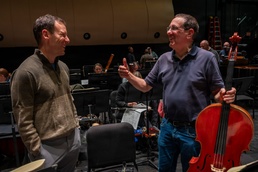
DAYTON, Ohio -- In the world of bombers and acquisition, precision is everything. But on January 28, Bombers Directorate leaders discovered that the same principles guiding a successful orchestra - clarity, trust, and unified purpose - also shape high‑performing Air Force teams. That understanding is why, on a cold night in downtown Dayton, Ohio, roughly two dozen members of the Bombers leadership team gathered at the Benjamin & Marian Schuster Performing Arts Center to move beyond theory and learn practical teamwork and management skills directly from the professional musicians of the Dayton Philharmonic Orchestra (DPO).
“The people who lead the organizations inside of our B1, B2, B21, B-52 teams are clearly ‘conductors’ of an orchestra,” explained Col Timothy Spaulding, Bombers Directorate program executive officer (PEO), during opening remarks.
It’s not a new concept to think managing a team is like conducting an orchestra. Each violinist has a part to play, literally and figuratively. The same is true for an individual contributor at the Air Force Life Cycle Management Center (AFLCMC).
Day-to-day, Bombers employees manage the modernization and sustainment of the Air Force’s total bomber fleet. The directorate supports Air Force Global Strike Command (AFGSC) and delivers combat capability when and where it is needed.
LEARNING THE BASICS OF CONDUCTING
Uniformed and civilian Airmen enjoyed the rare chance to sit on stage among the musicians as they rehearsed pieces from Dmitri Shostakovich and Yasushi Akutagawa.
Before rehearsal, the Airmen gathered in a circle, some meeting each other for the first time. DPO conductor and artistic director Keitaro Harada introduced himself, sharing his background and how he approaches his work on and off the podium.
After the formalities and a quick primer on orchestral music, Harada had the Airmen “conduct” a little using a Sousa march as an example.
“Down! Up! Down! Up!” Harada said while motioning the proper arm movements, balancing a cell phone playing the music. The Airmen mimicked him as best they could, searching for the beat.
Adding a progression of difficulty, the maestro then turned on the “U.S. Air Force Song” and explained a different arm motion, saying “Out! Up!”
THE ORCHESTRA AS AN ORG CHART
Thinking of a typical organizational chart, a PEO or conductor would be on top as the individual in charge of setting the vision that everyone else follows. This individual makes sure everyone is working toward a unified goal.
Further down the org chart, directors and department chiefs align with orchestral section leaders to ensure each area is completing required tasks, making suggestions for improvement, and providing support and advice to subordinates.
Section musicians and individual contributors in a division apply their training and skill to specific tasks that benefit the department, division, directorate, and ultimately, the organization.
As artistic director and conductor, Harada said he corrects mistakes when needed but never attacks or badgers - he simply expects the issue to be fixed and not repeated. “I have to be the person that, without saying, ‘Hey, play better, or do better, or be a better leader’ – [I need to] make them a better musician without saying that. And then let them do the best that they can and give them the environment to be able to thrive,” adds Harada.
CREDIBILITY MATTERS – A LOT
Another key lesson from Maestro Harada was the link between leadership and credibility. He emphasized that the strongest way to build authority is to understand the work, set expectations, and then step aside so the team can execute. His bottom‑line advice for leaders: don’t waste your employees’ time. Professionals can immediately tell whether a leader truly understands their job.
Bombers director of security Nick Phillips wholeheartedly agrees.
“If I told my people how to do their jobs, I would lose all credibility. But I lead them in what I want as the product, and I let them do it. I play to their skillsets.”
The Bombers team returned to the Schuster later in the week to watch the DPO’s full performance, gaining even more leadership insight simply by observing. Harada conducted the famous Shostakovich Symphony No. 5 without a baton - a choice that caught Col. Spaulding’s attention. He saw it as a metaphor for knowing when direct leadership is needed and when to step back and let experts do their work.
“There are times where [employees] know what they're doing. And directing is no longer your job, and knowing the difference is important,” explains Spaulding.
TAKING IT ALL IN
The Bombers group reflected on the offsite through three lenses: what they learned as “conductors,” what they learned as “musicians,” and where the metaphor fell short. One major insight was Harada’s macro‑micro‑macro approach - understanding the big picture, diving into the details, and then returning to the broader purpose. Applied outside the concert hall, it means leaders must know what matters, understand each person’s role, and translate mission and meaning to their teams.
They also recognized where the orchestral comparison breaks down. Musicians follow a precise score, while most Air Force employees don’t have that level of specificity.
Orchestras rehearse together in the same space; AFLCMC personnel are spread across time zones. And unlike a conductor with final say, military teams answer to multiple stakeholders.
Still, the larger parallel held: orchestral musicians succeed through shared goals, clear communication, disciplined practice, and a deep understanding of their roles - principles that resonated strongly with the Bombers team.
The Dayton Philharmonic Orchestra is a nonprofit organization and part of the Dayton Performing Arts Alliance. No federal endorsement implied.