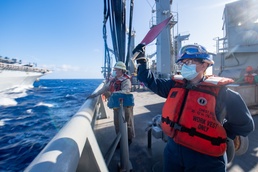
Military Sealift Command enhances the professional and personal growth of its Navy reserve Sailors by establishing three new Navy Enlisted Classifications (NECs) for cargo afloat rig team (CART) course graduates.
The CART courses are mandatory for Navy reserve Sailors assigned to rig teams who augment MSC combat logistics force platforms to provide support during underway replenishments, ammunition offload/onload evolutions, and exercises. Prior to the NEC establishment, Sailors graduating from the courses were awarded a certificate of completion only.
“Creating the NECs was a huge win for MSC and our reserve Sailors,” said Daniel Sheppard, deputy director of reserve affairs. “The establishment allows MSC to have a better tracking system of who has completed the training, as well as provides Sailors with greater opportunities in the fleet and in their career.”
Sheppard spearheaded the new NECs with support from Rear Adm. Kimberly Walz, acting commander for MSC at the time, who approved the request to be submitted for consideration thus becoming the first purely Selective Reserve NEC to ever be awarded, according to the Navy Manpower Analysis Center (NAVMAC), marking Feb. 4, 2026, as the official day of inception for the NECs.
According to Cynthia Kilpatrick, MSC reserve affairs program director and CART program coordinator, having one or more NECs in a Sailor’s electronic training record can be beneficial to the individual’s career path by providing a more robust record when approaching promotion opportunities.
“These NECs represent “C” level training as opposed to accession level training, making them more of a refinement of a skillset,” Kilpatrick said. “Additionally, if a Sailor is going up for promotion, a person with one or more NECs may present more credibility to their training than a person who has only completed the initial accession training.”
According to Kilpatrick there are approximately 145 reserve Sailors that complete at least one of the training courses each year, and the new NEC code will be retroactive to past students who will be assigned at least one of the three:
842A - Cargo Afloat Rig Team (CART) Phase I (RAS/FAS) Standard Tension Replenishment Alongside Method (STREAM) for Cargo/Fuels
842B - Cargo Afloat Rig Team (CART) Phase II Cargo Handling
842C - Cargo Afloat Rig Team (CART) Explosive Material Handling Equipment
“We will be able to go back to at least three years and update the training records with the correct NEC codes for those Sailors who graduated the training,” Sheppard added.
The training is facilitated at the MSC Underway Replenishment Training Center (MUTC) onboard Joint Expeditionary Base Little Creek-Fort Story with mockup demonstration areas and equipment to provide a real-world environment for practicing real-life simulations.
“For each associated course, the Sailors pallet and net cargo, use a winch booth and connected replenishment line to send and receive cargo pallets, and practice the different watch stations to include phone talker, safety observer, and line man,” said Kilpatrick. “Additionally, they practice maneuvering a forklift in a room to simulate operating aboard a shipboard environment.”
According to Cody Holliday, MUTC site director, there is currently a group of Sailors enrolled at MUTC who will be the first to receive the NEC codes upon graduation, Feb. 13, 2026.
“We currently have a class of 11 CART students in a Phase III course which is a combined course of Phase I and Phase II,” said Holliday. “It’s a three-week course and the students will earn both 842A and 842B NEC.”
The ability for MSC reserve Sailors to receive an NEC for their training fosters an environment that highlights the achievements and the readiness of U.S. reserve forces. The NECs will be reflected in the April 2026 edition of the Navy Enlisted Occupational Standards Manual (NAVPERS 18068F) Volume II.
“The training the Sailors receive is vital to their mission,” Sheppard said. “The NECs are an added bonus for the Sailor, the crew, and will improve our future workforce.”
MSC directs and supports operations for approximately 140 civilian-crewed ships that replenish U.S. Navy ships at sea, conduct specialized missions, preposition combat cargo at sea around the world, perform a variety of support services, and move military equipment and supplies to deployed U.S. forces.