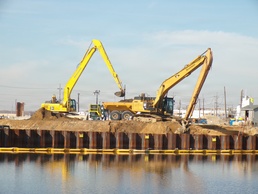
Since the 1980s, the U.S. Army Corps of Engineers and its partners have been engaged in a vital mission: cleaning up Hazardous, Toxic, and Radioactive Waste (HTRW) at historic industrial sites across the United States.
These legacy sites were typically hotbeds for industrial activity and production in past decades and centuries. In some cases, chemical residue, toxic waste and other pollutants went largely unmonitored before modern environmental laws and regulations. Whether buried underground, dumped on abandoned property, or discharged into rivers, these materials can pose a serious threat to human health and safety, as well as to aquatic life and the environment.
Although the Army Corps is well known for its congressionally funded engineering and civil works projects across the nation, the organization also completes reimbursable work for various federal agencies upon request.
Through a program called the International & Interagency Services Program, the Army Corps’ Philadelphia District supports the Environmental Protection Agency (EPA) with remediation activities at Superfund sites. This work involves safely processing these toxic materials and remediating sites. The Army Corps and EPA use a variety of methods to treat toxic waste, depending on the project.
Over the past year, the Army Corps’ Philadelphia District has been busy with remediation projects throughout EPA’s Regions 2 and 3, which span from New York to Virginia. In New Jersey alone, the District is currently working on eight active projects, preparing to take on another upcoming project, and providing technical support on three additional projects.
In Camden County, N.J., one Superfund site, Welsbach & General Gas Mantle, was once the location of a thorium lamp facility. The soil became contaminated with hundreds of different hazardous chemicals, many of which were used in gas lamps and other products later processed into radium.
“At sites like Welsbach, we work together with the EPA to clean up radioactive material in soil,” explained Emily Terjimanian, a project manager and remediation specialist with the Philadelphia District. “We’re doing a dig and haul project, where we don’t treat the soil in the ground or on site, just safely dig it up, load it onto rail cars, and ship it to facilities that specialize in storing the waste.”
In 2025, the Army Corps’ Philadelphia District shipped 264 total railcars of contaminated material from both Welsbach and the former DuPont Chambers Works site, another remediation site located in Deepwater, New Jersey. Radiological waste is typically transported by rail; other types of contaminated material are often removed by dump trucks.
Sometimes, material doesn’t always need to be removed from the site. Contaminated groundwater is sometimes treated “in situ” (in the ground) by injecting a solution to break down the hazardous elements. Water that can’t be safely treated this way is pumped out of wells and treated at groundwater treatment plants before recirculating it back into the environment.
These complex projects involve large teams of scientists and engineers, all working together to make sure contaminated soil and water is carefully processed and treated. The Army Corps’ number one priority is the safety of the neighborhoods surrounding these sites.
“This district has a proud, 40-year-plus track record of being very committed to the communities surrounding Superfund sites,” said Juan Carlos Corona, Chief of the International, Interagency and Environmental Support Branch at the Philadelphia District. “Our ultimate goal is to protect them from anything that could be hazardous to their wellbeing, through safe, efficient, complete and quick removal of any toxic waste in their community.”
In addition to providing support to EPA under the Superfund program, the Philadelphia District has been working on its largest HTRW project to date at the former DuPont Chambers Works plant in Deepwater, N.J. Under the Formerly Utilized Sites Remediation Program (FUSRAP), the Army Corps is cleaning up radioactive waste associated with Manhattan Project research that took place at the site during World War II.
This multi-phase project, which first started in 1998 and will cost around 501 million dollars to execute, is focused on processing waste material from uranium production and disposal. It is estimated to take another 19 years to complete.
With both a significant history of support and a robust modern-day focus on remediation, the Philadelphia District remains committed to managing complex remediation and supporting public health and safety across the region.