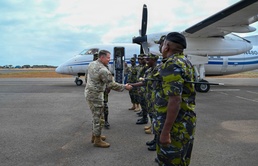
Covering more than 1,400 km in roughly 30 hours, U.S. Army Lt. Gen. John Brennan, deputy commander, U.S. Africa Command (AFRICOM), continued discussions on how AFRICOM and its partners can strategically counter terrorism in East Africa through various meetings and engagements with senior military leaders from the Kenyan Defence Forces in Nairobi and Manda Bay, Kenya, Feb. 5-6, 2026.
Accompanied by the Senior Defense Official/Defense Attaché for U.S. Embassy Nairobi, U.S. Army Col. Scott Polasek, Brennan’s message of how partnerships united by shared security interests are critical to enabling joint operations and security cooperation efforts resonated with the KDF’s top officials - Kenyan Gen. Charles Muriu Kahariri, Kenya Chief of Defence (CHOD) Forces; and Kenyan Maj. Gen. Abdulkadir Mohammed Burje, Director of Military Intelligence (DMI) for the Kenya Defence Forces.
“Kenya is a security anchor here in the region,” stated Brennan. “From hosting the command’s largest exercise in East Africa focused on enhancing peacekeeping capabilities or by participating in AFRICOM’s multilateral exercises to advance maritime security objectives, to synchronizing operational efforts to foster a safer, more secure, and prosperous East Africa, our partnership with the Kenyan Defence Forces is generational.”
Coming on the heels of the AFRICOM commander’s visit to Kenya with the U.S. Department of State Deputy Secretary, Brennan’s visit marked the command’s continued interest in deepening coordination, intelligence sharing, and strengthening joint efforts to counter terrorist threats from al-Shabaab and other violent terrorist organizations.
During the visit, Brennan gained insight into how continued partnership efforts between the U.S. and Kenyan defense forces were enabling KDF’s operational independence, agility, and technological capacity in cyber.
While at the KDF Moran Centre, Brennan and Burje discussed the value of cyber technology in promoting regional security.
Following Brennan’s time in Nairobi, where he and KDF leaders discussed the strategic value of the defense forces’ efforts, his visit shifted to seeing how the combined joint planning for training and execution manifests on Kenya’s northeastern coast.
Manda Bay
Located near the Kenyan naval base in Manda Bay, Camp Simba is a cooperative security location (CSL) where U.S. and Kenyan forces work collaboratively in a defense partnership to promote regional security and operations, supporting air, sea, and land missions.
At Camp Simba, U.S. service members and Kenyan partners are directly supporting counterterrorism operations in East Africa, particularly in Somalia.
“There are multiple threat groups in Somalia, one of which is ISIS,” Brennan said. “Our partnership and presence here with the KDF provides us a power projection platform. A lot of the operations that we conduct in northern Somalia and a lot of our ISR (Intelligence, Surveillance, and Reconnaissance) assets and our ability to medically evacuate our partners from Somalia emanate from here at Camp Simba.”
After arriving in Manda Bay, Brennan met with U.S. service members for an immersion on their operations and tactical support to this command’s greater mission of countering transnational threats.
According to Brennan, “The threats are very real. Our American service members play a strategic role in the fight against ISIS to prevent attacks on our homeland and global community. Without their presence, here, we couldn’t counter the threats to international security.”
Alongside U.S. service members’ efforts to counter extremist threats, some missions at Camp Simba are multilateral and advanced through the Combined Joint Inter-Agency Task Force (CJIATF).
As a multiagency team, the CJIATF’s joint initiatives focus on leveraging ISR coordination, information sharing, and synchronized efforts to sustain stability and address emerging security concerns across the region.
For Brennan, he described the multilateral relationship within the joint operations as highly effective, adding, “The partnership is very interoperable. We’re doing a lot of great work and making a lot of headway against al-Shabab to prevent threats from transiting from Somalia into Kenya.”
Though threats in East Africa persist, ongoing partnership efforts between the U.S. and Kenya’s military remain strong and evolve as the partners unite around shared objectives of promoting peace, security, and stability.