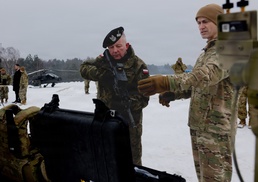
FORT KNOX, Ky. — The security landscape in Europe has shifted dramatically, forcing NATO to reassess how it deters a peer adversary in an era defined by speed, transparency, and technological change. The return of large-scale conventional warfare has made clear that static formations and traditional tripwire forces are no longer sufficient. Today's challenge is not simply presence, but denial - preventing an aggressor from achieving objectives from the opening moments of conflict.
As America's only forward-deployed corps, U.S. Army V Corps is working alongside NATO allies to develop the Eastern Flank Deterrence Initiative, or EFDI, a coalition-driven framework designed to reshape modern deterrence. Rather than relying on static defenses, the EFDL integrates sensing, decision-making and precision effects into a resilient, defense-in-depth concept intended to disrupt adversary decision cycles before large-scale combat begins.
“Deterrence on NATO’s eastern flank must be based on denial, not simply presence,” said U.S. Army Lt. Gen. Charles Costanza, commanding general of V Corps. “The Eastern Flank Deterrence Initiative is a NATO-led, coalition-driven framework that integrates persistent sensing, AI-enabled decision-making, and distributed precision fires into a single, cohesive defensive architecture that complicates an adversary’s ability to mass, penetrate, and achieve momentum. Our objective is clear: by combining emerging technology with deep allied integration, V Corps is helping build a faster, more resilient deterrent designed for the realities of 21st century conflict.”
The EFDI reflects a shift toward deterrence by denial, trading an adversary's mass for speed, precision, and adaptability. The concept creates a costly dilemma for potential aggressors: expend high-end munitions against low-cost, attritable, and often unmanned systems, or risk having formations exposed and degraded before achieving operational objectives.
A ubiquitous sensing through a layered network of U.S. and allied sensors, V Corps seeks to establish a persistent, all-domain understanding of the battlefield. Initiatives such as the 2nd Cavalry Regiment's experimentation with Soldier-borne radio frequency detectors and advanced small unmanned aerial systems contribute to a network designed to detect threats early and deny adversaries the element of surprise. Unmanned aerial systems and counter-unmanned aerial systems equipped with autonomous sensors provide Soldiers with improved situational awareness, enabling faster detection and response to emerging threats.
Rapid detection alone is insufficient without equally rapid decision cycles. Artificial intelligence continues to be integrated in V Corps operational processes through initiatives, which accelerate the military decision-making process (MDMP) by organizing and prioritizing large volumes of battlefield data. The 1st Battalion, 77th Field Artillery is currently attempting to integrate an AI-enabled language model to support the MDMP by identifying blind spots, enhancing terrain and sustainment analysis, and enabling faster, more informed course of action development.
According to Maj. Rafael E. Chico-Lugo, V Corps lead for Artificial Intelligence Decision Making, “ Capitalizing on emerging AI capabilities to alleviate the cognitive burden of staff work and expedite staff processes to better facilitate shared analysis for decision makers. The system should be capable of optimizing time by streamlining information into concise, shareable analysis; interpreting inputs from staff sections and automatically organizing them into structured briefs; incorporating and structuring external documents into accessible data inputs; and integrating with external operating platforms such as the Maven Smart System (MSS) to enable bi-directional data exchange for brief development.”
Combined with data visualization platforms such as Maven and integrated cloud-based systems, these tools create a shared operational picture across coalition partners, improving coordination and enabling faster, informed decisions at every echelon. The U.S. Army's Artificial Intelligence Acceleration Strategy further supports these efforts by enhancing platoon-level lethality through persistent digital sensing and data sharing, providing commanders with a digital spotter that never sleeps.
Once decisions are made, forces must act with speed and precision focusing on distributed and lethal effectors. The EFDI leverages a dispersed network of lethal and nonlethal capabilities, including High Mobility Artillery Rocket Systems, or HIMARS, enhanced through signature reduction techniques, and manned-unmanned teaming between the 12th Combat Aviation Brigade's AH-64 Apache helicopters and unmanned systems. Advanced capabilities such as the Spike Non-Line-of-Sight, or NLOS, missiles provide additional standoff lethality. At the same time, integrated data feeds allow AI-enabled sensors to cue fire assets against identified threats rapidly.
Attritable unmanned systems also play a central role by offsetting adversary mass at reduced cost, enabling sustained operations while preserving high-value assets. Mesh networks and self-healing communications architectures allow units to maintain connectivity and shared data feed even in contested electromagnetic environments.
The EFDI remains fundamentally coalition centric. V Corps continues to prioritize interoperability with NATO partners through shared technology, data-link experimentation, and joint training. Major exercises, including Combined Resolve, Avenger Triad, and upcoming Warfighter exercises, serve as testing grounds for integrated systems and operational concepts. These events move emerging technologies from experimentation into operational use while building the shared procedures and trust required for coalition operations.
"V Corps is uniquely positioned in Europe to drive innovation and transformation to fight and win against any future adversary across the EFDI," according to the V Corps Innovation Team. "Every day V Corps works closely with our subordinate Brigades to develop and deploy new and innovative capabilities to confront the emerging threats of today's modern dynamic battlefield. The goal of V Corps Innovation Activities is to get emerging technology, at scale, into the hands of our warfighters to build combat credible capabilities within U.S. Army Europe's EFDI."
Through continued innovation, training, and allied integration, V Corps aims to strengthen operational readiness across NATO's eastern flank while preventing conflict before it begins. As the corps prepares for future validation exercises such as SWORD 26 and continued transformation activities in Europe, leaders emphasize that modern deterrence depends on the ability to learn, adapt, and integrate faster than any potential adversary.
V Corps continues to shape a new model of deterrence for the 21st century — one built on speed, integration, and coalition strength.
-30-