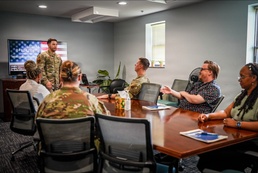
JOINT BASE LANGLEY-EUSTIS, Va. -- For one Equal Opportunity professional, military service is more than a career choice, it’s a family legacy.
Coming from three generations of service, U.S. Air Force Tech. Sgt. Fabian Carbajal, 633d Air Base Wing EO specialist, describes their family as part of the “warrior class.” Both of his grandfathers served, one as a Marine and the other as a Sailor. His father followed in the Marine Corps before retiring from the National Guard. Today, the tradition continues: Carbajal and his siblings all serve.
“I knew I wanted to serve,” Carbajal said. “I also wanted to travel and get out of my hometown. The Air Force gave me that opportunity.”
Before retraining into EO, he spent nearly a decade in the Intelligence career field as an imagery analyst. “I used to joke that I played ‘I Spy’ for a living,” he said. “Intel was exciting and meaningful work, but I felt like I had reached the limits of what I could do there.”
An opportunity to retrain came through the Noncommissioned Officers Retraining Program after the Air Force experienced overmanning in the intelligence field. For Carbajal, the decision to retrain was both professional and personal.
“I want to be a guidance counselor when I get out of the military,” he stated. “So, I looked for jobs that aligned with my long-term goals. EO felt like the right fit.”
The transition from intel to EO was a huge change in what his day-to-day work.
“In Intel, you’re part of the spearhead,” he said. “You’re directly supporting the mission by providing intelligence for strikes. EO is further back on the spear, more like the shaft or the handle, but that doesn’t make it any less important.”
Rather than supporting a single mission set, EO supports every mission on the installation, serving Airmen and civilians at all levels.
“Our job is to make sure the spear doesn’t fall apart,” He explained. “We support Airmen, civilians, and sometimes even families so that people can do their jobs without being affected by things that shouldn’t matter in the workplace.”
The support that EO provides, largely behind the scenes, enables the Air Force to attack the mission and strengthens our warrior ethos by encouraging mental resilience and getting Airmen the help they need with challenging situations.
“When people feel heard, treated fairly, and supported, they’re more confident,” they said. “That confidence empowers them to lead, to take care of their wingmen, and to stay engaged in the mission.”
By being open and approachable, EO can handle disputes or other issues that can hinder Airmen from performing at their highest level. The challenging part is that many people don’t realize that EO is not a scary place; it is not all about crime and punishment.
“We try to remind people that EO isn’t some mysterious office you should be afraid of,” he said. “We’re people. I’m Sergeant Carbajal. This is my team. You can come talk to us.”
Much of that connection is built through unit visits, facilitation sessions, and Alternative Dispute Resolution. ADR allows EO professionals to serve as trained facilitators or mediators, helping members resolve workplace conflicts voluntarily and collaboratively.
“It could be an Airman Basic and an O-6, two peers, a civilian and a supervisor; it really runs the full spectrum,” Carbajal stated. “And what happens in facilitation stays in facilitation. We use professional judgment, explain reporting requirements up front, and protect information whenever possible. And reprisal for using a helping agency is not tolerated.”
While EO cases can take time due to the need for precision and due process, Carbajal believes the impact is worth it.
“People come in stressed, frustrated, sometimes at their breaking point,” they said. “If they leave knowing there’s a path forward and someone advocating for them, that matters.”
Beyond casework, the EO team has prioritized improving internal processes and caring for its own personnel.
“We’re one of the busiest EO offices in the Air Force,” Carbajal explained. “There are only about 300 EO professionals total, and we’re consistently in the top five busiest installations.”
To manage the workload, the team overhauled outdated tracking systems, reorganized the office to create a calmer environment for visitors, and emphasized recognition and professional development.
They also created temporary administrative positions for Airmen across the installation, giving selected E-4 through E-6 members hands-on experience in a helping agency while easing the office’s workload.
“The idea was to give Airmen growth opportunities while strengthening our office,” Carbajal said. “They’ll go back to their units stronger, with better perspective and leadership skills.”
What stands out most to Carbajal is when Airmen take care of other Airmen.
“I’ve seen wingmen walk in together, supervisors advocating for their people, and first sergeants using EO as a support and not a last resort,” he said. “That tells me the system is working.”
For Carbajal, EO isn’t just about policies or procedures. It is about people.
“If we’re doing our job right,” he said, “we’re helping Airmen stay focused on the mission, take care of each other, and keep the Air Force strong.”