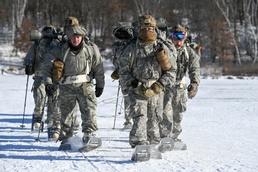
Three Massachusetts Air National Guardsmen joined airmen from 17 states and two countries to compete in the Cold Weather Operations Course at Camp Ripley Training Center in Minnesota, Jan. 19-31, testing their physical endurance, mental resilience and teamwork in subzero conditions.
After classroom instruction on cold-weather injuries, risk management and equipment use, 2nd Lt. Michael Anderson, Tech. Sgt. Vincent Pizzi and Senior Airman Thomas Yurek, 102nd Security Forces Squadron (SFS) defenders, completed six days of hands-on field training in harsh weather conditions. The course was hosted by personnel assigned to the 148th Fighter Wing, Minnesota Air National Guard.
“The instructors made it clear on multiple occasions that they could not make the course more difficult than what the weather and environment already presented,” Anderson said. “The largest challenge was learning to operate without a formal shelter in the elements, exposed to the extreme weather conditions.”
Operating in continuous extreme cold, the 102nd SFS defenders joined their teams in applying survival skills in land navigation, fire building, hypothermia response and shelter construction. Carrying 65-pound rucksacks and wearing seven-level Extended Cold Weather Clothing System (ECWCS) and snowshoes, they traveled more than 25 miles across snow-covered terrain while teams pulled 350-pound sleds, training, sleeping and operating outdoors.
“It’s an extremely physically demanding course, but the physical aspect pales in comparison to the mental strain of enduring the cold,” said Pizzi. “You’re constantly convincing yourself that it’s temporary and that you can push through. In my 10 years across the Army, Navy, and now the Air Force, it was the hardest thing I’ve ever done, not because of the 65-pound rucks or pulling a 350-pound sled, but because of the relentless mental challenge of the cold.”
Participants built thermal shelters from limited materials, digging into the ground and breaking through permafrost to sleep outdoors. They also had to dispatch, clean and prepare wildlife for food, relying solely on the resources they carried.
“The most important thing I learned was how to build a thermal shelter using only what we had in our rucksacks,” Yurek said. “My partner and I used a slanted downed tree for cover, insulated the frozen ground with pine needles and debris, secured ponchos to block the wind, and relied on our sleeping systems to retain heat, learning how to trap warmth, block wind and prevent heat loss to the ground.”
In the final test, participants plunged into a frozen lake to intentionally induce hypothermia. They then relied on their teams to recover and apply the skills they had learned over the course, demonstrating their ability to respond under extreme conditions.
“It’s a huge confidence boost to realize you can handle something like that,” Yurek said. “At the start of the field training exercise, it feels almost impossible, but you keep pushing through and learn that nothing lasts forever. As the finish line gets closer, especially on that final day when you jump in the water and know it’s over, you realize just how much you’re capable of overcoming.”
The three Massachusetts National Guardsmen were joined by security forces, medical and intelligence airmen from across the United States, as well as Canadian infantry soldiers. Airmen from Puerto Rico, Vermont, California and several other states brought varied perspectives and expertise from their units and career fields, contributing to problem-solving and team cohesion to keep teams performing at the highest level.
“There was no rank involved in this,” said Pizzi. “We were placed in different positions and leadership roles, but everyone started on the same baseline. It was valuable to step away from our normal day-to-day responsibilities and focus on working together to get through it. You also saw how different people reacted, and even those from warmer climates brought useful perspectives and skills that helped the team succeed. Everybody found their role and came together as a cohesive unit.”
After successfully completing the course, Anderson, Pizzi and Yurek plan to return to Otis Air National Guard Base and share the skills and knowledge they gained with their fellow defenders. They will help integrate cold-weather survival techniques into unit training, improving readiness for operations in austere environments.
“During the 102nd SFS’s upcoming overnight exercise in Massachusetts, we’ll face similar weather conditions,” Pizzi said. “Being able to share what I learned, especially with those who haven’t operated in austere cold environments, will be incredibly valuable. Even simple lessons, like how to keep your fingers and toes warm or trust your issued gear, can make a major difference.”
Additionally, the CWOC supports the Air Force’s agile combat employment (ACE) concept by preparing airmen to operate effectively in harsh, remote environments where large, established bases may not be available or secure.
“Much of the next conflict could arise in an Arctic contested environment that will require Airmen to excel and defeat threats while exposed to the extreme conditions,” Anderson said. “Having qualified individuals in the unit with the knowledge to move and perform in this arena will be crucial for the unit to meet those future threats.”
ACE relies on dispersed, forward operating locations and rapid maneuver to reduce vulnerability and increase survivability. CWOC builds those same skills by training airmen to survive, move and operate in extreme cold with limited resources.
“Understanding the ACE concept and being prepared to rapidly pick up and move at a moment’s notice is critical, especially as near-peer adversaries like Russia and China compete for influence in the Arctic,” Pizzi said. “If conflict were ever to arise in that region, having these cold-weather skills would be a significant asset, not just for our unit, but for the broader Air Force mission.”