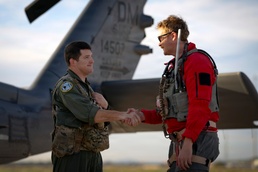
DAVIS-MONTHAN AIR FORCE BASE, Ariz. — U.S. Air Force rescue aircrews from the 563rd Rescue Group, supported by Air Forces Southern, conducted a long-range water rescue of a civilian aboard a tanker in the Pacific Ocean off the coast of Mexico, Feb. 5, 2026.
The mission underscored how training, experience and cross-unit integration enable Air Force rescue forces to respond when time, distance and personnel availability converge.
The mission began when the Air Force Rescue Coordination Center received a request for assistance from the crew of the Maran Gas Olympias, a Greek-flagged liquefied natural gas tanker operating more than 340 nautical miles offshore. A civilian aboard the vessel was experiencing a serious medical emergency that required immediate advanced medical care.
Due to limited helicopter pilot availability stemming from ongoing training and operational commitments, leaders from the 563rd Rescue Group reached out to U.S. Air Force Lt. Col. Jeff Budis, Air Forces Southern operations directorate, chief of exercises and airshows. An HH-60W Jolly Green II pilot with over 2,000 flight hours, Budis was asked to integrate into the operation based on his extensive rescue experience. While assigned to AFSOUTH, Budis maintains his rescue pilot qualifications and continues flying with the 563rd RQG to remain mission ready.
“This mission is a shining example of what rescue does,” Budis said. “Being ready to go at the drop of a hat—that’s why we train the way we do. These missions are unpredictable. They don’t come around often, but when they do, you have to be ready. Training is what makes that possible.”
Budis served as an aircraft commander and supporting flight-lead, overseeing mission planning and execution, including fuel planning, risk management and long-range overwater coordination.
“The call wasn’t about where I was assigned—it was about having the right experience available when it was needed,” Budis said. “My role was to integrate into the team and help execute the mission safely.”
Two HH-60W helicopters assigned to the 55th Rescue Squadron, supported by an HC-130J Combat King II, launched toward the vessel. The extended distance required detailed mission planning, multiple helicopter air-to-air refuelings, and close coordination across aircrews, pararescue teams and tanker crews. The 79th RQS HC-130J conducted the refueling events, transferring more than 13,000 pounds of fuel to extend helicopter range and time-on-station.
“Flying hundreds of miles over open ocean is inherently high risk,” Budis said. “If anything goes wrong during air refueling, you’re suddenly talking about more survivors than the one you were sent to save.”
Once on scene, 48th RQS pararescue personnel boarded the vessel and assessed the patient, determining he required evacuation to receive a higher level of care. While the primary medical team conducted the initial assessment, supporting aircraft managed fuel and timing constraints to ensure the mission could continue safely.
“They packaged the patient on the bow of the ship, hoisted him off, and we flew through the night to Cabo San Lucas,” Budis said. “From there, he was transferred to Mexican medical authorities for continued treatment.”
The patient was transported ashore in stable condition.
Capt. Nate Delaney, 55th RQS chief of plans and exercises and HH-60W pilot who flew alongside Budis during the mission, said the operation highlighted the strength of standardized training and trust across the rescue enterprise.
“Even when crews don’t fly together every day, the standards are the same,” Delaney said. “Everyone understood their role, trusted the plan, and focused on one thing—getting the patient the care he needed and bringing the team home safely.
“We fly with different people all the time, but we all train to the same standards,” added Delaney. “That’s what allows us to trust each other and execute every mission safely.”
The mission demonstrated the Air Force rescue community’s ability to rapidly integrate qualified personnel across multiple units, even as crews were dispersed to training events and operational commitments.
The 563rd Rescue Group, based at Davis-Monthan Air Force Base, routinely conducts rescue training and operations to maintain readiness for personnel recovery, humanitarian assistance and emergency response missions in support of U.S. objectives worldwide.
“It comes down to standards and training,” Budis said. “We fly with different people all the time, but we all train to the same standards, so we know what to expect and how to trust each other.”
For Budis, missions like this directly inform his work overseeing exercises and training across the U.S. Southern Command area of responsibility.
“Everything I do in exercises is informed by real missions like this,” Budis said. “It’s easy to draw from real experience when planning and training.”
At the end of the day, Budis said the mission reflected the core principle that drives the Air Force rescue community.
“These things we do - That others may live.”