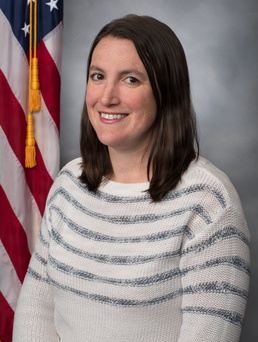
MARINE CORPS AIR STATION CHERRY POINT, N.C. – Some people are assigned the role of mentor, while others simply become one. For Katie Graf, mentorship has never been a box to check or a title to hold–it’s a natural extension of who she is. That instinctive commitment to helping others succeed is what earned her the 2025 Fleet Readiness Center East (FRCE) Mentor of the Year Award.
Graf, who serves as the depot logistics lead for the C-130 Fleet Support Team at FRCE, was recognized Jan. 21 during the Naval Air Systems Command 2025 Mentor of the Year Award Ceremony for her commitment to guiding junior employees, helping them develop the skills, knowledge and confidence needed to grow professionally in their careers.
Since childhood, Graf has found joy in helping and teaching others, she said, serving as a drum major in high school and often participating in leadership programs. That early passion for leadership and teamwork has stayed with her throughout her career, making this recognition especially meaningful. Graf said this honor reflects the dedication of her team, one that consistently shows up ready to learn, grow and improve together.
“It’s really cool to think I have made such an impact on people here, so much so that they would take the time to nominate me for this award,” Graf said. “I’ve always had a passion for teaching, being involved and organizing things, and that is why I like mentoring so much. I enjoy sharing knowledge and helping them learn and understand because the more they know, the more they grow and the more they can do.”
Tyler Brownlow, logistics specialist for the C-130 Fleet Support Team, said he nominated Graf for this achievement after experiencing firsthand the way she helps others succeed. He said in a short amount of time, she helped him navigate complex information and concepts, often going out of her way to offer guidance – something he said was never asked of her but instead, she did naturally.
“Her natural and innate mentorship skills have had profound impacts on the C-130 Fleet Support Team, FRC East and me,” said Brownlow. “I came from a very corporate background so when I came here, it was like learning a new language, an incredibly complex language, in fact. Katie is a great translator, which is hard to come by. She is able to take what we are looking at, filter out all the noise, and leave us with something that is actually tangible to work with.
“What’s most remarkable is that no one never had to ask her to be a mentor or great leader; she stepped into that role effortlessly,” he continued. “Many of our other team members echo this sentiment. That authentic dedication and clear impact on personnel, the Fleet Support Team and FRC East, is why she deserves this recognition.”
Graf began her career at FRCE as a summer hire when she was just 16 years old. Throughout high school and college, she spent her summer and winter breaks working with the H-46 program office building modification kits. Upon graduating from college, she became a contractor at FRCE before taking on a formal position at the depot as a production controller in 2015. She then spent time in the depot’s business office before transferring to the H-60 Fleet Support Team, where she worked in maintenance planning and supply support.
In early 2024, Graf accepted an opportunity on the C-130 Fleet Support Team to help stand up the depot’s C-130 worksite at the North Carolina Global TransPark in Kinston. Graf and Brownlow have since worked on the C-130 team together, often being assigned rotational employees every six months to help with the project. Brownlow said these rotations are a great way to give teams more manpower and provide employees with opportunities to expand their organizational knowledge and gain new skills but with that, they also require a good amount of onboarding.
“We are in a unique position where Katie and I are the only two people who have been able to stay on this project the entire time,” said Brownlow. “Every six months, we get new teammates who work with us on a rotational basis. That means Katie has to educate, train and onboard a whole new team every six months. With the complexity of the project we are working on, that isn’t an easy task but she does it seamlessly.”
Beyond her depth of knowledge, Brownlow said Graf takes the time to explain how something is done, and also why it is done that way. Graf said she believes understanding the “why” is a critical stepping stone in the learning process, which is why she focuses on sharing that information with her mentees.
“The ‘why’ is really important when helping people understand what we are doing. It shows them why we are doing a thing, why it’s important, in addition to what the impacts of the decisions and choices we are making can be,” she said. “It helps us get a better understanding of the bigger picture, increasing our awareness and forward thinking, which is especially important because what if there is different choice that we could advise that would have a better outcome in the future?”
Brownlow said Graf’s guidance helps each mentee grow individually, while making the team stronger, more capable, and better prepared to take on new challenges and support the warfighter.
“Katie has empowered us to ask questions, take risks and learn from our mistakes,” said Brownlow. “She’s always teaching and challenging us with work outside of our comfort zones, which makes the whole team stronger. Because of her, we’re not just completing tasks; we’re contributing with a strategic understanding that would have taken years to develop on our own. It’s been an organic process driven by her desire to see the warfighter and our team succeed.”
Graf said one of her priorities as a mentor is ensuring her mentees feel valued and appreciated for their contributions, something she believes is essential to building confidence and professional growth.
“As a mentor, I often think about interactions I’ve had with previous supervisors and the people who I have leaned on for guidance throughout my career. I’ve learned that anyone can provide their mentees with technical help, like answering questions and solving problems, but the way they treat their team is what actually matters,” she said. “How we respond to situations and how we show our teammates that they are valued is key. I want to make sure the people who are working with me know that I appreciate them and see all that they do.”
Graf recently was assigned her first official mentees through the NAVAIR Journey Leadership Development Program, a career development program for civilian and military personnel that helps prepare junior-to-mid level staff for additional leadership responsibilities. Graf said she looks forward to beginning to work with them.
“These will be my first two official mentees, which is cool because they ended up with me because other coworkers of theirs who I have worked with in the past suggested me to them,” said Graf. “It’s very fulfilling to see how my willingness to talk to and help anyone has paid off and now other people are sending mentees my way. I’m always happy to show someone the what or the why, or explain what I think about the situation. I’m always happy to have someone come sit with me and to share what I know.”
Graf said she views mentoring as an investment, one that not only helps individuals grow but also ensures the team is better equipped to support fleet readiness.
“An important thing to remember is that we are better together than separately,” said Graf. “By developing folks and helping them learn and figure out things themselves, we are setting ourselves up as a command with a more informed and capable workforce.
“For example, something I often explain to my mentees is how the choices they make affect the fleet, as we are fleet support,” she continued. “How are the decisions we make today going to impact our depot’s artisans or our uniformed service members tomorrow? I try telling them how, even though it may not seem like it, the impact of the decision they make today can have a cascading effect. It’s really important that they understand that because it helps us work together better and produce a quality product for the warfighter.”
FRCE is North Carolina's largest maintenance, repair, overhaul and technical services provider, with more than 4,000civilian, military and contract workers. Its annual revenue exceeds $865 million. The depot provides service to the fleet while functioning as an integral part of the greater U.S. Navy; Naval Air Systems Command; and Commander, Fleet Readiness Centers.