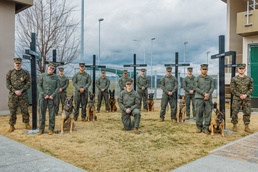
MARINE CORPS AIR STATION IWAKUNI, JAPAN — The constant echoes of hammers and
saws fade after a long sixteen hours of sweat and tears, dusk begins to fall. The scent of fresh
wood and paint lingers in the air. Marines stand in silence with a sense of pride, looking at a
legacy that will carry on for generations of United States Marine Corps military working dog
handlers. Eight wooden crosses tell a powerful story that only a few will understand.
At Marine Corps Air Station Iwakuni, a memorial stands strong outside of the military working
dog kennels, serving as a reminder to those Marines of their purpose and mission; to remember
the eight military working dog handlers who paid the ultimate sacrifice in Iraq and Afghanistan.
U.S. Marine Corps Sgt. Jesse Pena, a military working dog handler with MCAS Iwakuni, carried
forth a tradition he learned as a junior Marine at his first duty station, Marine Corps Base Camp
Pendleton, California.
“The whole purpose of your job was to make sure that those men up at the crosses were
remembered. So as a Lance Corporal in Camp Pendleton, I was taken up to the crosses and I
was told, ‘this is the legacy that we always remember,’” said Pena. “This is the reason why we
do our job, and we learn from our mistakes that we committed in the past, and we make sure
that these men are never forgotten.”
In 2017, a memorial of eight crosses bearing the names, Sgt. Adam Cann, Staff Sgt.
Christopher Wrinkle, Cpl. Max Donahue, Cpl. Dustin Lee, Staff Sgt. Christopher Diaz, Cpl.
Keaton Coffey, Sgt. Joshua Ashley and Cpl. David Sonka, was created for the friends and
families of the fallen dog handlers who lost their lives in Iraq and Afghanistan. The K-9 section in
Camp Pendleton, hosts an annual memorial ceremony with an organization called The Dawgs’
Project, bringing the friends, families and the K-9 community together again to keep their names
alive.
“They were out there serving the country with their military working dogs. Some of these men
were attached to either reconnaissance units, or Marine Force Special Operations Commands
out there in the front. One of our biggest, I guess, quotes or sayings is ‘canine leads the way’
because our dogs are the ones that lead.” said Pena.
Around the world service members continue to honor the legacy of those who came before
them. After arriving at MCAS Iwakuni in October of 2024, Pena realized a lot of junior handlers
didn’t understand the names or history behind what they do and why they do it, so he made it
his personal mission to create a memorial of their own.
“I started off with a memorial wall dedicated to those men, and then I started putting crosses
and the initials of these men on our unit logo.” Said Pena. “I found it to be very important that we
build these crosses here, being that we only have those crosses built in one location across the
whole Marine Corps. So, I went ahead and started the project here.”
Before 11 military working dog handlers felt the warmth of the sun, they gathered together at
0600, all with the same goal and determination. The Marines sacrificed a total of 16 hours
cutting wood, nailing it together, painting it and digging holes, all while receiving help from their
spouses who searched for and laminated photos of the fallen service members and stenciled
each name to the eight crosses. At 2300, the crosses were put up, illuminating the darkness.
Sgt. Pena’s personal mission was finally complete.
“I gave a speech to my guys, and we all kind of went around and said, our part, emotions were
very high, some tears were shed for those men. Prayer was said, and now we use it as a
memorial site and a site to make sure that generations from here on out will remember these
men and learn about these men. They're not just names on Google; their names are in our
facility. Every time these guys go in and out of the kennels, they remember the sacrifices that
were made for us to be here and to learn from the past.”