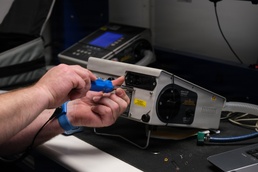
FORT DETRICK, Md. – U.S. Army Medical Logistics Command is continuing to boost medical equipment readiness, reduce downtime and increase overall enterprise visibility through its Forward Repair Activity-Medical, or FRA-M, program.
Over the first 12 months of operation, technicians at the first FRA-M site at Fort Bragg completed over 1,600 maintenance service requirements for units on or near the North Carolina installation.
In total, the program has bridged a gap for more than 1,200 units without organic biomedical equipment specialists and ensured over 17,000 medical devices received required sustainment-level maintenance.
The FRA-M name is a rebrand from the program initially launched in October 2024 – known as Home-Station Medical Maintenance Support, or HMMS. The change better aligns medical with naming conventions used by other Army sustainment commodities, such as communications and weapons systems, which utilize Forward Repair Activities for maintenance needs.
“The first year has gone very well,” said Alfred Zamora, deputy director of the FRA-M program under AMLC’s Medical Maintenance Management Division, or M3D. “One of the things we quickly learned during setup was the importance of coordinating with the organizations on the installation, simply so they’d know that we’re there and what capabilities we can provide.”
The Fort Bragg FRA-M site is staffed with four technicians ready to provide regular maintenance and repair services for medical devices to units without organic 68A biomedical equipment specialists. Similar setups are planned for additional sites set to come online over the next few years.
Zamora said the next site is planned for Fort Campbell, Kentucky, expected to open in a temporary space this March before moving into its renovated, permanent location by early summer.
Additional FRA-M sites are planned at Fort Benning in Georgia, Fort Hood in Texas, Fort Carson in Colorado and Joint Base Lewis-McChord in Washington, along with AMLC’s Medical Maintenance Operations Divisions, or MMODs, in Pennsylvania, Utah and California.
AMLC, a major subordinate command to U.S. Army Communications-Electronics Command, delivers integrated medical logistics that enables Army and Joint Force readiness from the strategic support area to the tactical edge.
The FRA-M program is one of the first major improvements put in place under an AMLC-led effort called Medical Logistics in Campaigning, or MiC, which aims to integrate medical logistics and equipment services into the wider Army sustainment enterprise, ensuring medical capabilities remain aligned with warfighter requirements.
The establishment of FRA-M at home stations, specifically, will have a significant impact on operational readiness and support capacity, Zamora said.
“FRA‑M closes a longstanding gap in Class VIII medical maintenance by delivering targeted, on‑site support where it was previously unavailable,” he said.
Before the FRA-M sites, units without maintainers in their ranks had to coordinate with their local medical treatment facilities, or MTFs, for support or ship equipment back to one of the MMODs, taking equipment out of service for extended periods of time.
Additionally, the MTFs, now a function under the Defense Health Agency, used different information systems that “didn’t talk” to the Global Combat Support System-Army, the Army’s sustainment system of record.
“When work was processed, the hospital techs weren’t in the Army system, so the information about the equipment was never put into G-Army,” Zamora said, “so some historical records about our equipment weren’t accurate.
“Having a fixed-base operation through our FRA-M sites simplifies the process for the units, saving time and money, all while improving visibility for commanders and total readiness of the force.”